What changed in the new Dietary Guidelines & why it matters
Alexander Raths - stock.adobe.com.
On Jan. 7, 2026, HHS and USDA released the 2025–2030 Dietary Guidelines for Americans (DGA, or “Guidelines”), the much-anticipated 10th edition of the nation’s foundational nutrition policy document. The Guidelines shape federal nutrition programs, food standards, and nutrition education that reach at least one in four Americans.
While the new Guidelines retain some science-based recommendations from past versions, they also depart sharply from both the 2020–2025 Guidelines and the independent scientific report issued by the 2025 Dietary Guidelines Advisory Committee (DGAC). USDA and HHS rejected more than half of the DGAC’s recommendations and relied on a new Scientific Foundation report instead of the DGAC’s transparent, science-driven process.
What changed, how did we get here, and why does it matter?
What the new DGA says: Some key content changes
Core limits remain—but with contradictory guidance
Like previous editions, the 2025–2030 DGA still calls on Americans to limit saturated fat, added sugars, sodium, sugar-sweetened beverages, and alcohol, and to emphasize fruits, vegetables, and whole grains. However, amid this positive advice is harmful guidance to emphasize animal protein, butter, and full-fat dairy, guidance that undermines both the saturated fat limit and the 2025 Dietary Guidelines Advisory Committee’s science-based advice to emphasize plant-based proteins to reduce cardiovascular disease risk.
“Evidence indicates that when reducing butter, processed and unprocessed red meat, and dairy, substitution or replacement with a wide range of plant-based food sources, including plant-based protein foods (e.g., beans, peas, and lentils), whole grains, vegetables, or mono-unsaturated fatty acid (MUFA)-and PUFA-rich vegetable oils and spreads, is associated with cardiovascular disease risk reduction.” - 2025 Dietary Guidelines Advisory Committee Scientific Report, p. 17
Increase in protein
The types of recommended protein food groups aren’t the only part that changed. The new Guidelines also changed the amount of recommended protein: The 2020 Guidelines recommended 5.5 ounces of protein per day for someone eating a 2,000 calorie diet, while the new 2025 DGA recommends three to four 3-ounce servings of protein, or up to 12 ounces per day on the same 2,000 calorie diet. Over the course of a week, that could add up to 84 oz of animal protein, compared to the 26 ounces per week recommended in the 2020 Guidelines. Now, that’s only if someone chooses to strictly eat meat, poultry, or seafood for their weekly protein sources, which they would be encouraged to do if they followed the new Guidelines for advice. While the 2020 Guidelines recommended splitting your protein intake between three food groups (meat, poultry, and eggs; seafood; nuts, seeds, and soy products), the new dietary pattern doesn’t specify how many servings of each protein food group a person should aim for in a day, and the Guidelines specifically say to “consume a variety of protein foods from animal sources,” before listing plant-sourced protein options.
No more subgroups
The new Guidelines also remove distinct vegetable subgroups from the dietary pattern, reducing clarity around how to eat a balanced diet within the vegetable and protein categories. For example, the 2020 DGA recommended different weekly amounts of beans, peas, and lentils (1.5 cups), plus dark-green (1.5 cups), red and orange (5.5 cups), and starchy vegetables (5.5 cups), while the new Guidelines just recommend three daily servings of all types of “vegetables” for a 2,000 calorie diet. This is an issue because different types of vegetables and proteins provide different nutrients—have you heard the phrase “eat the rainbow”? There’s a reason for that colorful advice!
In other words, someone following the new Guidelines could eat 4 daily servings of red meat and 3 servings of white potatoes and technically meet their recommended protein and vegetable food group requirements, even though they may have nutrient shortfalls. This would be an issue for individuals, but also for food service programs that have to translate the food group recommendations in the new Guidelines into meals and menus for nutrition assistance programs (like school meals) that are currently aligned with the recommendations for variety from past Guidelines.
Vague alcohol guidance
The food subgroups aren’t the only thing that lost detailed recommendations in the new Guidelines. When it comes to consuming alcohol, the 2020 Guidelines specifically told consumers that they do “not recommend that individuals who do not drink alcohol start drinking for any reason,” and to “choose not to drink or to drink in moderation by limiting intake to 2 drinks or less in a day for men and 1 drink or less in a day for women, when alcohol is consumed,” and included a cautionary statement that “alcohol has been found to increase risk for cancer, and for some types of cancer, the risk increases even at low levels of alcohol consumption (less than 1 drink in a day).”
The new Guidelines simply state “consume less alcohol for better overall health.” While this guidance is not incorrect, it is more vague and does not highlight the health risks of any level of alcohol consumption.
Focus on highly processed foods
While the Guidelines have long recommended prioritizing nutrient-dense, minimally processed foods in your diet, the 2025 Guidelines explicitly recommend limiting “highly processed foods.” The “Limit Highly Processed Foods, Added Sugars, and Refined Carbohydrates” section carries over advice to limit sugar-sweetened beverages from the 2020 Guidelines but also includes stricter guidance on added sugars: the 2020 Guidelines recommended “less than 10 percent of calories per day starting at age 2.” The new Guidelines remove the 10 percent per day limit, but state: “while no amount of added sugars or non-nutritive sweeteners is recommended or considered part of a healthy or nutritious diet, one meal should contain no more than 10 grams of added sugars,” and “no amount of added sugars is recommended” through age 11, while the 2020 Guidelines only recommend avoidance through age 2. Zero sugar for kids may be difficult for parents and schools to implement in the current food environment.
A new food pyramid
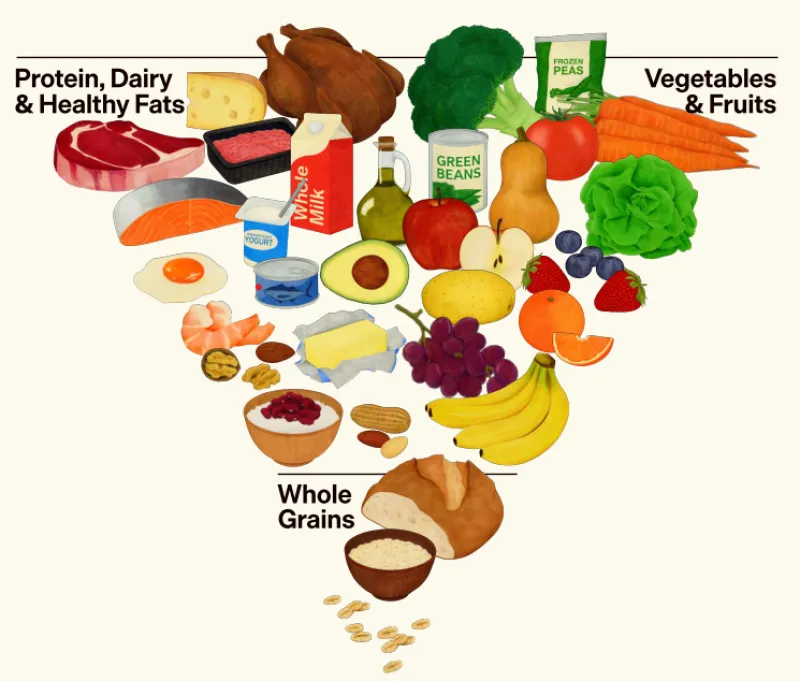
To visually communicate these changes, HHS and USDA have published a new, inverted food pyramid. As a reminder, the Guidelines officially stopped using the Food Pyramid in 2011. The government created the MyPlate visual, which clearly demonstrated the proportions of different food groups that you should have on your plate: half for fruits and vegetables, and the other half for grains and protein. Despite this, Secretary Kennedy claimed at a January 7th White House press briefing to have “righted” the Food Pyramid.
HHS/USDA.
The new food pyramid strongly emphasizes protein through the placement of images of steak, ground beef, chicken, salmon, whole milk, cheese, and yogurt (among others) at the top of the pyramid—while de-emphasizing grains with their placement at the bottom of the pyramid, even though the recommended number of grain servings (2-4) in the new recommended dietary pattern remains similar to other food groups (3-4 for protein and 3 for dairy, for example). The visual is meant to be consumer-facing guidance, but this new pyramid fails to accurately represent the dietary recommendations.
In summary
The 2025–2030 DGA maintains longstanding guidance to eat fruits, vegetables, and whole grains and limit saturated fat to less than 10 percent of daily calories, but also:
Advises people to consume double or more of the recommended amount of protein each day,
Promotes red meat and full-fat dairy,
Describes butter and beef tallow as "healthy” cooking fats,
Removes detail on protein and vegetable subgroups and alcohol guidance, and
Removes any serving recommendation for refined grains in the dietary pattern.
These recommendations sharply contradict the conclusions of the 2025 DGAC, which found that:
Replacing butter, red and processed meat, and full-fat dairy with plant-based proteins, whole grains, vegetables, and unsaturated vegetable oils is associated with reduced cardiovascular disease risk.
How the Guidelines were made: A break from scientific norms
The typical, transparent DGAC process
The DGA are typically developed through a multi-step, evidence-based process overseen by the USDA and HHS. The Guidelines are updated every five years to reflect the latest high-quality science. During each round, USDA and HHS choose topics for review and appoint an independent panel of 10-20 experts outside the government called the Dietary Guidelines Advisory Committee (DGAC, or the “Committee”). DGAC members are publicly nominated and must have more than ten years of experience related to at least one of the topics that will be examined and an advanced degree in nutrition or a related field. The Committee members are also chosen to reflect a diversity of points of view and expertise.
Reviewing the evidence takes the Committee around two years because it’s a very rigorous process.
This is how it played out with the 2025 DGAC. The group of 20 nutrition experts with diverse perspectives conducted food pattern modeling and systematic reviews based on publicly posted research protocols, presenting their findings along the way at seven public meetings. Their recommendations were then peer-reviewed by external experts, and their final “Scientific Report” was open to public comment after publication.
Typically, USDA and HHS integrate recommendations from the report as they write the final Guidelines. In 2020, USDA and HHS posted a public justification for the two recommendations they did not include from the 2020 DGAC.
To read more about the typical process, check out our explanation of how the Dietary Guidelines are developed.
What happened this time
In this cycle, the administration rejected more than half (30 of 56) of the DGAC’s recommendations—particularly those supporting plant-forward dietary patterns and cautioning against consuming saturated fats. Instead, it commissioned a new “Scientific Foundation for the Dietary Guidelines for Americans,” written by hand-picked authors whose work aligned with beef, dairy, and protein supplement industry interests and the administration’s preconceived policy goals. The Scientific Foundation document states, “the central concern with the DGAC Report was that all scientific questions were evaluated through a health equity lens,” using the consideration of race, ethnicity, culture, and socioeconomic status as a reason to dismiss the Committee’s scientific review.
Major flaws in the new “Scientific Foundation”
CSPI has identified multiple serious scientific problems with this new report, including:
Lack of transparency: The selection of the scientific committee, identification of questions for them to review, protocol development, and review process occurred behind closed doors with no public meetings or opportunity for public input.
Inconsistent standards of evidence: This report started from a baseline assumption (or “principle”) that all minimally processed, naturally nutrient-dense foods are healthy, with no scientific justification. However, the report simultaneously required strong causal evidence to justify any recommendations that countered that assumption—including those to encourage highly processed foods or discourage red meat, butter, or full-fat dairy.
Methodological weaknesses: An inconsistent mix of reviews was used, but most reviews were narrative, which are not systematic and are prone to author bias. Furthermore, these reviews were often authored by a single individual, which makes them even more prone to bias. This is an issue, because...
Conflicts of interest: Most (seven of nine) authors have clear ties to beef, pork, dairy, and high-protein supplement/food companies that stand to benefit financially from these protein-heavy Guidelines.
Internal contradictions: The DGAC conducts food pattern modeling analyses to ensure their recommendations make sense as a whole across a full dietary pattern, and will help individuals achieve the correct amount of calories, macronutrients, and micronutrients while meeting food group serving requirements. This new review did not involve comprehensive food pattern modeling, leading to internal contradictions in the final guidelines: One could follow the Guidelines’ food servings recommendations and subsequently consume more than 10% of calories from saturated fat, for example.
Use of non-generalizable studies: Weight-loss trials and professional society position statements about the nutrition needs of competitive athletes were used to justify population-wide nutrient and food intake recommendations, resulting in guidance that is inappropriate for the average healthy American (e.g., recommending that highly active individuals may need to increase sodium intake).
Errors and missing justifications that call the credibility of the entire report into question. For instance, the scientific foundation appendices do not justify the elimination of a daily quantitative limit for added sugars, or the limiting of added sugars to 10 grams per meal (if they are consumed).
Why this matters
The Dietary Guidelines directly shape the diets of tens of millions of Americans, because they are used to inform federal nutrition standards for the National School Lunch and Breakfast Programs, the Special Supplemental Nutrition Program for Women, Infants, and Children (WIC), the Child and Adult Care Food Program (CACFP), Food Distribution Program on Indian Reservations (FDIPR), meals offered through Older Americans Act programs and the Department of Defense, and more. In other words, the Guidelines influence the meals that children, older adults, and military personnel are served and the food that families can buy with WIC benefits.
Check out this resource to see the reach of the Dietary Guidelines through public policies and food programs.
By discarding a rigorous, transparent scientific process in favor of an opaque and conflicted one, the 2025–2030 DGA undermine the scientific integrity of federal nutrition policy—and risk steering Americans toward dietary patterns that increase, rather than reduce, chronic disease.
CSPI heavily relies on our grassroots donors to fuel our mission. Every donation—no matter how small—helps CSPI continue improving food access, removing harmful additives, strengthening food safety, conducting and reviewing research, and reforming food labeling. We don't take donations from corporations, and our flagship publication, Nutrition Action, doesn't run any ads. That means that everything we do is fiercely independent and unbiased from any bad actors, no matter how powerful. To help keep this online content 100% free, consider donating today to support CSPI.