Nearly two million people are behind bars in the United States. Do they deserve nutritionally inferior food? Do they deserve inadequate portions of unpalatable, over-or undercooked meals? Do they deserve food that is spoiled, rotten, or contaminated?
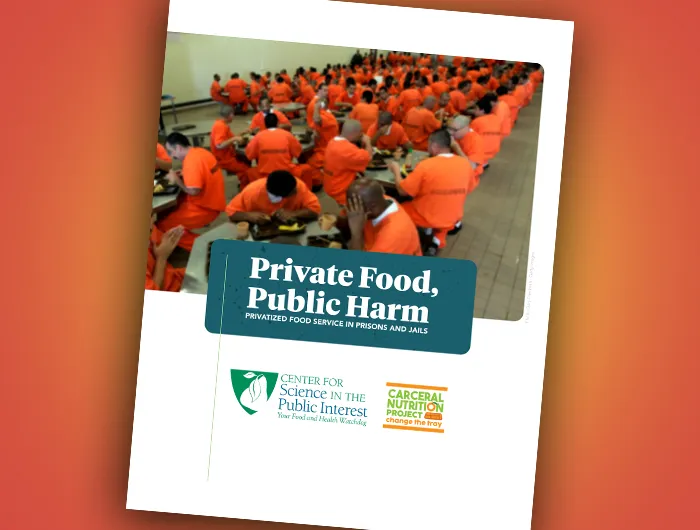
Well, that’s exactly what many of them are being served, particularly in prisons and jails that have outsourced their food service operations, according to a new report from the Center for Science in the Public Interest (Nutrition Action’s publisher) and the Carceral Nutrition Project.
Private Food, Public Harm: Privatized Food Service in Prisons and Jails details how the health and well-being of hundreds of thousands of people in prisons and jails are being compromised by companies’ push to generate profits.
A major offender: Aramark, a multinational corporation that now holds roughly 35 percent of the US correctional food service market.
It would be surprising if any American carceral facilities were truly feeding people well. But privatizing operations—a decision typically justified as a way to cut costs—has made a bad public health disparity even worse.
While it’s not even clear that moving from in-house food service to companies like Aramark saves money, what is clear is that the shift often compromises the quantity, quality, and safety of the food incarcerated people are served.
And that can put them at increased risk not just of food poisoning but, eventually, of chronic conditions like heart disease and type 2 diabetes.
Not surprisingly, it comes down to money...with the lowest bidder—often Aramark—prevailing.
Clearly, we have a failure in public health practice.
How to correct it? With greater transparency, stronger public oversight, and approaches to food service that prioritize the health and nutrition of incarcerated people over contractors’ bottom lines.
Specifically, we need independent monitoring, standardized nutrition guidelines, and greater accountability for private contractors who operate correctional dining facilities.
Incarcerated people may be locked up, but they don’t deserve to have their basic human dignity violated when they pick up their forks.
CSPI heavily relies on our grassroots donors to fuel our mission. Every donation—no matter how small—helps CSPI continue improving food access, removing harmful additives, strengthening food safety, conducting and reviewing research, and reforming food labeling. We don't take donations from corporations, and our flagship publication, Nutrition Action, doesn't run any ads. That means that everything we do is fiercely independent and unbiased from any bad actors, no matter how powerful. To help keep this online content 100% free, consider donating today to support CSPI.