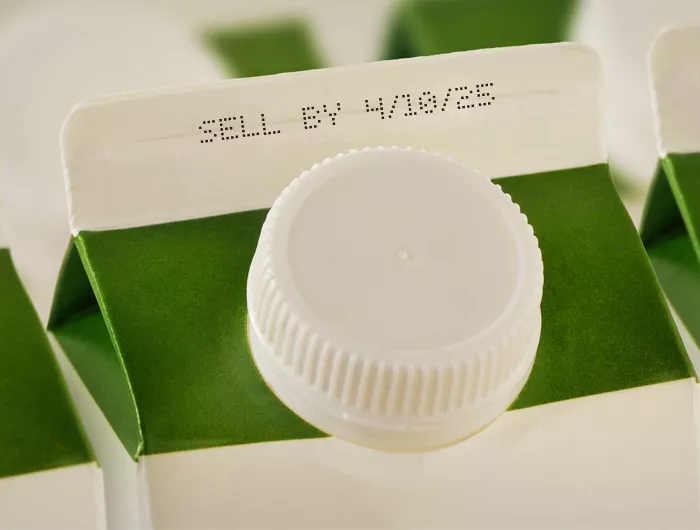
A 2025 nationally representative survey found that consumer confusion around food date labeling led 88% of consumers to discard food near the package labeling date at least occasionally. Clarifying and standardizing date labels could lead to a reduction in food waste across the board.
Confused about food date labels? You’re not alone
Have you ever opened your refrigerator and pulled out a food item and found yourself confused by the date listed on the package? Perhaps the item still looks and smells fine but has passed its “best by” date. Do you eat it or toss it? Is it still safe to eat? You’re not alone in this conundrum. It’s remarkably confusing!
Food waste and date label confusion
Approximately 30% of food in the US goes unsold or uneaten, often ending up in landfills or incinerated. Meanwhile, almost one in seven American households (about 18 million households) are food insecure. In 2024, the US wasted over 3.5 million tons of food, costing approximately $20 billion, due to date label confusion alone.
You read that right: Confusing date labels cost an extraordinary amount of money each year. The good news is this is a problem that can be solved.
The benefits of reducing food waste are wide-reaching, and standardizing date labeling would translate to financial savings across the spectrum. Standardizing date labels would have a net financial benefit of $3.8 billion per year, the large majority of which would be savings to consumers. On average, each year consumers in the US spend more than $762 on food that is ultimately wasted.
Currently, the federal government does not regulate or offer guidance on the use of on-package food date labels, except for on infant formula. This results in a haphazard and confusing patchwork of state regulation and voluntary labeling.
The pitfalls of ‘sell by’ date labels
Research shows that many consumers incorrectly believe that date labels indicate the date after which food is no longer safe to eat. In reality, date labels are most often a manufacturer’s estimate of a product’s optimal quality.
A 2025 survey found that consumer confusion around food date labeling led 88% of consumers to discard food near the package labeling date, at least occasionally. Much of the confusion comes from challenges with interpreting the labels, inconsistent placement, poor legibility, and label-type meanings.
Further, some products carry a “sell by” date, which is used to inform retailers about stock rotation but can mislead consumers. As such, this type of “sell by” information should be coded in a way that retailers can identify but isn’t confusing to consumers.
This confusion continues throughout the food system and impacts what foods are discarded instead of donated. Oftentimes, food that is still safe to eat and could be used or donated gets thrown out due to confusion about the safety of the product.
The federal government should take action to standardize clear quality and safety dates
CSPI recommends that the federal government take action and require date labeling. If a quality date (i.e., the date after which the quality of the item may deteriorate) is warranted, we recommend that products be labeled with “BEST If Used By.” When a discard or safety date (i.e., the date after which the item should not be consumed) is warranted, we recommend using the term “Expires On.” An alternative safety indicator to “Expires On” is “USE By.”
The federal Food Date Labeling Act of 2025 would do just that. This bill would create a consistent and standardized labeling mechanism for on-package date labels. Labeling will continue to be voluntary. However, any manufacturer that chooses to label their product will need to use “USE By” to indicate the date until which the product is safe and “BEST If Used By” to indicate optimal freshness and quality. This legislation has widespread support, with over 30 major food manufacturers and retailers endorsing the bill.
The fine print
We also recommend allowing products to be labeled with “or freeze by” following a uniform quality date label phrase. In other words, “best if used or freeze by” would be allowed. Finally, we recommend reducing consumer confusion by ending the consumer-facing use of “sell by” dates.
Food label information should be designed to ensure it captures consumers’ attention on packaging that is often crowded with other information. Federal date labeling practices should encourage a minimum font size with type color that contrasts with the package background and encourage manufacturers to ensure this information is centrally located and set apart from other label elements. Icons or symbols that help indicate safety have been shown to increase the perception that a label is a safety label.
Finally, it is critical that date labeling enhances food safety while reducing waste. There should be strong empirical evidence for the date chosen for safety labels, and any research done on safety should be conducted in a way that maximizes shelf life.
Take action: Support standardizing and clarifying food expiration date labels