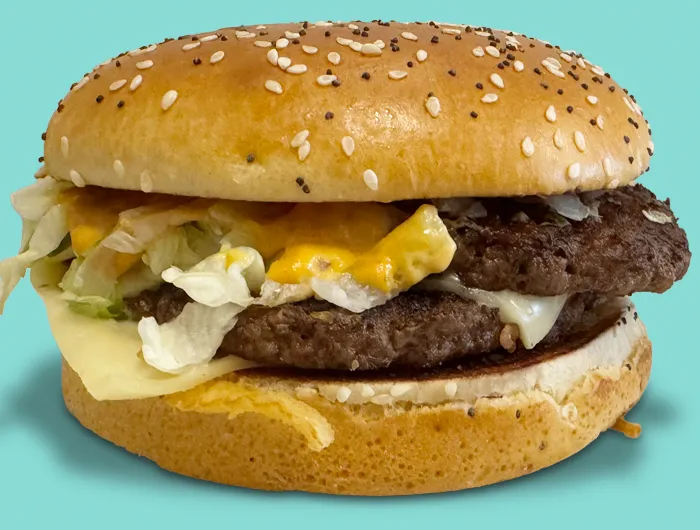
“McDonald’s is going BIG. Like, really BIG,” announced the chain on March 3. “Introducing the Big Arch Burger: a premium flavor experience that delivers BIG with every bite.”
What’s in the new limited-time-only burger, and just how “big” does it go on unhealthy fat, salt, and more? And what—if anything—is “premium” about a pile of beef, processed cheese, and white flour? Here’s a look.
What’s in a Big Arch Burger
The Big Arch Burger has as much beef as a Double Quarter Pounder with Cheese, but with three slices of cheese instead of two, plus lettuce, onion, pickles, “Big Arch Sauce,” and “crispy” (fried) onions piled high on a white-flour bun.
So it’s no surprise that a Big Arch has more saturated (unhealthy) fat, sodium, added sugars, and calories than a Double Quarter Pounder with Cheese, a Big Mac, or any other burger on McDonald’s menu. (The Big Arch’s 10 grams of added sugars come from the sauce and the burger bun.)
All told, a Big Arch Burger will set you back:
- 1,020 calories
- 25 grams of saturated fat (more than a full day’s recommended maximum)
- 1,760 milligrams of sodium (three-quarters of a day’s max)
- 10 grams of added sugars (20 percent of a day’s max)
| | Calories | Saturated fat | Sodium | Added Sugars |
| Big Arch Burger | 1,020 | 25 g | 1,760 mg | 10 g |
| Double Quarter Pounder with Cheese | 740 | 20 g | 1,360 mg | 8 g |
| Big Mac | 580 | 11 g | 1,060 mg | 5 g |
A Big Arch has almost twice the calories—and more than twice the sat fat—of a Big Mac. Calorie-wise, the Big Arch is like eating a stack of four McDonald’s hamburgers. Bigger, but certainly not better.
What if you order the Big Arch as part of a bigger-than-big “Big Arch Meal” that features the new burger, a medium order of fries, and a medium Coke (or other soft drink)? Now you’re looking at:
- 1,610 calories
- 27 grams of saturated fat (enough to hit your max for all of today and a third of tomorrow)
- 2,085 milligrams of sodium (just shy of a full day’s worth)
- 80 grams of added sugars (more than a 1-1/2-day supply)
Why is the Big Arch Burger going viral?
If you’ve heard about the Big Arch Burger, it may not be because of its size.
“McDonald’s C.E.O. Takes a Big Bite Out of a Burger. Maybe Scratch ‘Big.’” That was the March 5 New York Times headline describing the chain’s unintentionally viral video about the burger.
The backstory: McDonald’s CEO Chris Kempczinski “bit into the burger tentatively, almost primly,” explained the Times, in a video that other news outlets described as having a “hostage-like quality” as Kempczinski is seen “taking a very small bite.” Mmm.
McDonald’s calls the Big Arch ‘premium.’ But is it?
McDonald’s says that the Big Arch is “a love letter to fans who simply can’t get enough” and a “premium flavor experience.” Really?
For starters, the patties are “layered with three slices of melty white cheddar cheese^.” That little caret points to another line down below: “^Pasteurized process white cheddar cheese.” How premium!
While the Big Arch’s white-cheddar color may look upscale compared to the bright-yellow cheese in a Big Mac or Quarter Pounder, the two processed cheeses’ ingredient lists are identical, except for the “color added” in the yellow. (Both consist of milk, cream, water, sodium citrate, salt, cheese culture, citric acid, enzymes, and soy lecithin.)
Why does that matter? Processed cheese often has more sodium than regular cheese, which explains why the Big Arch’s three slices pack a salty wallop. Their 560 milligrams of sodium deliver a quarter of your daily recommended max.
And like other McDonald’s burgers, the Big Arch comes on a white-flour bun. It’s simply dressed up with a sprinkling of poppy seeds.
As for the “game-changing” Big Arch Sauce: Meh! It’s mostly water, oil, tomato paste, vinegar, sugar, egg yolk, and salt, with a smattering of flavors, spices, lemon juice concentrate, modified corn starch, and xanthan gum.
That’s some “love letter”!
More on burgers, beef, and cheese
While the Big Arch Burger is bad, some burgers from sit-down restaurant chains like Applebee’s and Chili’s somehow manage to be worse. Here’s what to know about them.
For more on why cheesy beef burgers are unhealthy for both people and the planet: