A big fat mess: 8 things to know about unhealthy fat
Emin - stock.adobe.com.
“We are ending the war on saturated fats,” proclaimed HHS Secretary Robert F. Kennedy, Jr., in January as he announced the 2025 Dietary Guidelines for Americans (DGA). Not so fast. Here’s the good and the (mostly) bad in the new DGA, what the sat fat promoters get wrong, and why the sat fat debate won’t go away.
1. Multiple kinds of evidence align.
If you read Nutrition Action, you’re no stranger to the case for limiting saturated fat. But when everyone from social media influencers to RFK, Jr., claims that sat fat doesn’t matter, it’s worth a refresher on why it does.
“The evidence is quite compelling from multiple aspects,” says Frank Hu, chair of the nutrition department at the Harvard T.H. Chan School of Public Health.
LDL cholesterol
“There is no question that high saturated fat diets raise LDL, or ‘bad,’ cholesterol,” says Hu.
In one of the most comprehensive analyses, researchers looked at the effect of swapping saturated fats for polyunsaturated fats (think vegetable oils, nuts, and seeds) in 69 well-designed feeding trials. For every 1 percent of calories from sat fat replaced with polys, LDL fell by a little more than 2 milligrams per deciliter. That’s impressive.
And few findings in medical research are as solid as the link between LDL and cardiovascular disease.
High LDL levels are not simply a risk factor for heart disease. They’re a direct cause, say the American Heart Association, American College of Cardiology, and others. That’s based on evidence from more than 200 studies (including randomized trials) on more than two million participants.
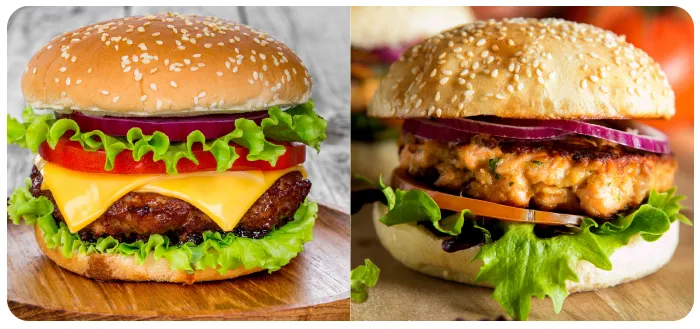
Love a burger? To cut the sat fat, swap the beef for salmon and ditch the cheese.
Photos - stock.adobe.com: Andrei Armiagov (beef burger), Leckerstudio (salmon burger).
Observational studies
“Another very consistent line of evidence comes from large observational studies,” says Hu.
He’s talking about studies that ask people what they eat, then follow them for years or decades. And those studies have shown that substituting unsaturated for saturated fats slashes the risk of cardiovascular disease.
Randomized trials
Randomized trials are the only type of study that can prove cause and effect. A common criticism from sat-fat deniers: No trials link saturated fat to heart disease.
That’s misleading, though it’s true that the trials that have been done are far from perfect. For starters, many were conducted in the 1960s and ’70s.
“Researchers were still figuring out what good trials look like,” says Kevin Klatt, an assistant professor in the department of nutritional sciences at the University of Toronto. “And it’s often hard to tell exactly what they did.”
That’s because many of the published papers didn’t report the same level of detail that is standard today.
What’s more, the relationship between diet and heart disease was just emerging. Some studies, for example, only measured total cholesterol because investigators didn’t yet know how important LDL was.
Even with those limitations, some things stand out. For example, Klatt and his colleagues recently combined the results of six older trials. In those that were designed to have people replace saturated fat with polyunsaturated fat, the risk of a heart attack was reduced by 25 percent over roughly four years.
But results from the older trials, while important, are just “a small piece of the puzzle,” says Klatt. “Because we don’t have massive blockbuster trials that are definitive, you really have to triangulate across multiple lines of evidence.”
And that evidence largely points in one direction: Too much saturated fat increases the risk of heart disease.
2. A blockbuster trial is unlikely
If a definitive saturated-fat trial doesn’t exist—and if its results could settle the debate—why not run one?
Three big issues: time, money, and compliance.
In 1962, a committee supported by the National Institutes of Health estimated that a randomized trial to test the impact of fats on coronary heart disease in middle-aged US men would require a whopping 100,000 volunteers and take 4 to 5 years.
Then, in 1971, a follow-up analysis by a federal task force concluded that a so-called National Diet-Heart Trial was not feasible, in part because it would need to be so long and so large that it would cost an estimated $500 million to $1 billion or more in 1971 dollars. And the volunteers would be unlikely to stick to their diets over the length of the trial.
Another important consideration: “Given the data that we already have in terms of saturated fat’s effect on LDL cholesterol and cardiovascular outcomes, I don’t think it’s ethical to assign people to a high-saturated-fat diet for five years or longer,” says Hu.
3. It matters what you replace sat fat with
If the best evidence on saturated fats points in one direction, why do RFK, Jr., and others claim that it points the other way?
They’re often relying on studies that don’t consider what people replace saturated fat with.
For example, unless someone is trying to lose weight, if they cut back on sat fat, they’re going to eat something else instead. And that something else is typically unhealthy carbs.
“In studies—both observational and clinical trials—that compare saturated fat with refined starch and added sugar, it’s a wash for heart health,” says Hu.
“But that doesn’t mean saturated fat is good. It just means that sat fat, refined starch, and added sugar are all bad in different ways. It’s an illogical argument.”
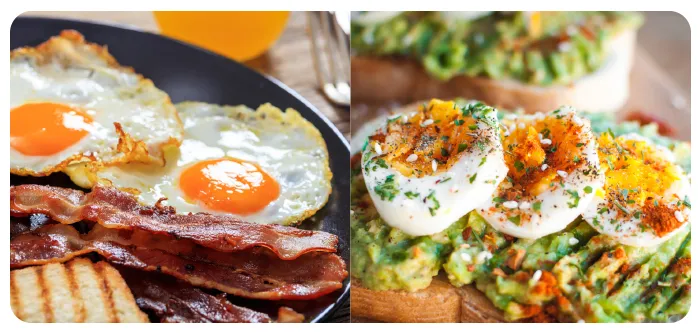
In other words, don’t swap your bacon for white toast and jam and think you’ve done your heart a favor. A better swap: avocado.
That’s because the strongest evidence favors replacing saturated fats with unsaturated fats—that is, vegetable oils, nuts, seeds, avocado, and so on. (Switching from sat fat to whole grains is also good, but switching to unsaturated fats is better for your heart.)
In a recent study that followed more than 220,000 people for up to 33 years, participants with the highest intake of vegetable oils (like olive and canola) had a lower risk of dying during the study than those with the lowest intake. Substituting about two teaspoons of butter a day with plant-based oils was linked to a 17 percent lower risk of early death.
For a lower-sat-fat breakfast, swap out bacon for avocado.
Replacing butter with olive oil or a vegetable-oil-based spread probably seems like a no-brainer. But what does the evidence show about replacing other sat-fat-rich foods?
That was one of the questions posed to the latest Dietary Guidelines Advisory Committee—a group of 20 experts who pore over the body of evidence to make recommendations for the final Dietary Guidelines for Americans.
“The comparisons were wide open,” says Christopher Gardner, professor of medicine at the Stanford University School of Medicine, who led the committee’s review of sat fat.
“It could be a lower-saturated-fat version of the same food—high-fat versus lean beef, say—or a totally different food—beef versus chicken or beef versus beans.”
The evidence from studies that ask people what they eat, then follow them over time, clearly indicates that you’re better off eating fats from plants (though not coconut or palm oil) rather than fats from animals.
For example, “if you substitute beef with beans, peas, lentils, or nuts, heart disease risk is lower,” says Gardner. “Do you know that it’s because of the saturated fat? No, but we weren’t saying that.”
And that kind of advice is easier for people to follow than telling them to track how many grams of saturated fat they eat, Gardner points out.
One wrinkle: When the advisory committee looked at clinical trials that compared red meat (beef, pork, or lamb) to white meat (chicken or turkey), they didn’t find the clear differences in LDL cholesterol that you’d expect.
Most varieties of red meat—especially ground beef—are higher in saturated fat than white meat, so red meat should have more potent LDL-raising effects. But it’s likely that the committee didn’t find a difference because those trials are often designed to show no difference.
Since the 1990s, studies—they’re typically funded by the beef industry—have reported a similar impact on LDL when researchers pitted very lean cuts of red meat against white meat.
Those results don’t exonerate the saturated fat in red meat. They simply show that saturated fat boosts LDL whether it comes from red or white meat.
5. Dairy is complicated
Roughly 50 to 60 percent of the fat in milk, cheese, and yogurt is saturated. That’s why lowfat or nonfat dairy has been a mainstay of recommendations to reduce heart disease risk.
So why do many meta-analyses of observational studies (hint: they’re often funded by the dairy industry) report that dairy or high-fat dairy isn’t linked to an increased risk of heart disease?
Again, it largely comes down to the foods you’re comparing dairy to.
“We conducted a substitution analysis to simulate the effects of replacing one food with another for predicting cardiovascular disease,” says Hu.
“We estimated that if you substitute dairy fat with plant-based fats from foods like nuts, beans, or soy, the risk is lower. But if you substitute dairy fat with fats from red meat and processed meat, the risk is higher."
And in rigorously conductedrandomized trials, dairy fat raises LDL. Some types of dairy—like butter—may raise LDL more than others—like cheese. But those differences seem to be small, especially compared to how low LDL levels go in study participants who have been fed diets high in healthy, unsaturated fats.
You might expect that plenty of trials have pitted whole milk against lowfat or skim and measured key outcomes like LDL, weight, appetite, and more.
But “there’s surprisingly little out there,” says Gardner. “How has that obvious question not been answered?”
(He notes that he’s on the advisory board for a group running that kind of trial now. We’ll keep you posted.)
More studies are needed to say whether the fermentation that foods like yogurt undergo or other characteristics of some dairy foods can have a neutral, or even positive, impact on your health, as some proponents claim.
But it’s not as though trials show that the saturated fats in meat and dairy offer health benefits that might offset their negative impact on LDL.
So it makes sense to eat mostly lowfat and nonfat dairy to keep your sat fat intake in check. While there’s likely room in healthy diets to eat a little full-fat dairy, it’s limited. But if your diet is already loaded with fatty red meat and butter, you’d be smart not to add any more.
6. The new Dietary Guidelines fumbled on sat fat
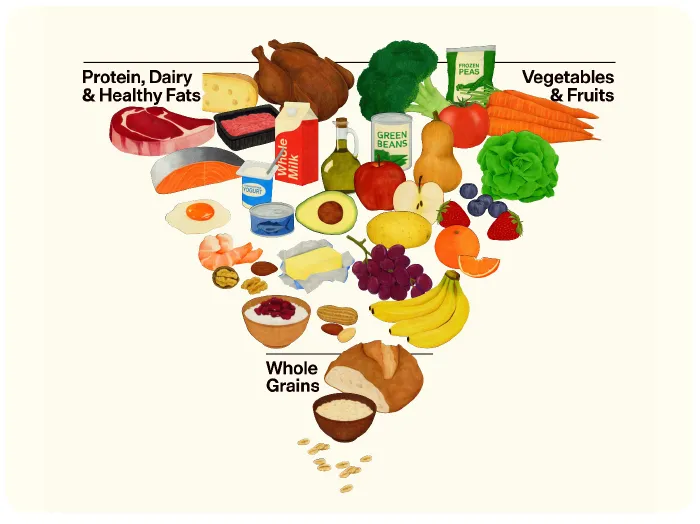
Ignore the new food pyramid’s advice to eat more red meat and full-fat dairy.
USDA and HHS.
In January, the government released its new Dietary Guidelines for Americansand an accompanying upside-down food pyramid that put red meat, cheese, and whole milk near the top.
First, the good news. “I think it’s really important that the Guidelines retained the long-standing limit of no more than 10 percent of calories from saturated fat,” says Hu. (For a 2,000-calorie diet, that shakes out to about 20 grams a day.)
For saturated fat, that’s where the good news ends. The new Guidelines ignored what Gardner calls “exhaustingly thorough and systematic” evidence-based recommendations from the Dietary Guidelines Advisory Committee.
Instead, the new Guidelines recommend high-sat-fat foods like red meat and full-fat dairy, and they call butter and beef tallow “healthy fats.” But that’s not consistent with the 10 percent cap on saturated fat.
“If you do the math, it’s very difficult to eat full-fat dairy, meat, and butter while keeping saturated fat below 10 percent of calories,” says Hu. “It’s like saying, ‘Follow a low-carb diet, but eat more bread.’”
So if you (like many Americans) haven’t paid much attention to the Guidelines, now is not the time to start. But just because you might be able to ignore this messy guidance, it doesn’t mean the mess doesn’t matter.
The Guidelines have formed the backbone of US nutrition policies for nearly half a century, shaping what foods can be consumed or purchased by children and adults in federal nutrition programs like school lunches and WIC (the Women, Infants, and Children program).
What about everyone else?
“I think the average American is going to be even more confused,” Gardner predicts. “Trust in science is eroding. This just adds to that erosion.”
7. Pay attention to your whole diet
While nutrients like saturated fat matter, don’t lose sight of the forest for the trees.
“I don’t think individual people need to be fixated on saturated fat,” says Hu. “Instead, it’s important to put it into the context of an overall dietary pattern.”
Take cheese, a major dairy food in the average American’s diet.
Let’s say you sprinkle some cheese on top of a salad full of vegetables and beans, or you eat a serving of cheese with whole-grain crackers and fruit. That’s very different than eating cheese in cheeseburgers, pizza, burritos, pasta, or other dishes high in refined carbs, red or processed meats, and salt.
“It’s okay to have some full-fat dairy or even red meat occasionally in a healthy diet,” Hu notes. “But those animal foods should not be the foundation. It’s not a good idea to go back to the meat-centric plate of the 1950s and 1960s.”
8. The sat fat debate rages on
For most nutrition experts, the evidence for cutting back on saturated fats and replacing them with unsaturated fats is solid. So why are we still talking about it?
“There are interested industries that are always going to fund studies on this,” Klatt points out. He’s talking about the dairy and red meat industries. And studies they pay for are often designed to show neutral or positive effects of their products.
“But people also love a ‘We used to think this, and now we don’t’ story,” he adds. “So researchers are always chasing after that. You see it all the time in nutrition: sodium, fat, sat fat, carbs.”
What’s more, what we eat is complex. And studying that complexity is hard.
“People are not using the same measuring stick to try and see through the hazy fog of how diet affects chronic disease,” says Klatt.
“Nutrition science will always lend itself to someone taking legitimate limitations in the evidence, and weaponizing them so that they can write a diet book or develop an entire persona around being a truthsayer.”
“It’s a lot of things happening at once, and then you throw all of that into a contrarian, Make-America-Healthy-Again-influencer ecosystem, and any semblance of the truth can become a casualty.”
CSPI heavily relies on our grassroots donors to fuel our mission. Every donation—no matter how small—helps CSPI continue improving food access, removing harmful additives, strengthening food safety, conducting and reviewing research, and reforming food labeling. We don't take donations from corporations, and our flagship publication, Nutrition Action, doesn't run any ads. That means that everything we do is fiercely independent and unbiased from any bad actors, no matter how powerful. To help keep this online content 100% free, consider donating today to support CSPI.
Despite health experts’ recommendations to cut back on saturated fat, you’ve likely heard that you don’t need to worry. What’s the truth? We’ve got answers.