Is soy a superfood or a hormone disruptor? The science can be confusing. Can you tell soy fact from fiction? Here are four persistent myths, and the science on soy, estrogen, testosterone, cancer, and soy foods for babies and kids.
Myth: The ‘plant estrogens’ in soy cause hormonal imbalances in women
Phytoestrogens are compounds in plants that resemble the estrogen in our bodies (though they’re not actually a type of estrogen). And soybeans contain a group of these hormone lookalikes called isoflavones.
“Isoflavones are structured very much like the estrogens humans produce,” says Xiao-Ou Shu, a professor of cancer research and epidemiology at Vanderbilt University School of Medicine. “To some extent, they can bind to our estrogen receptors. Sometimes people hear this and worry that these compounds might disturb our bodies’ hormone levels.”
But the research on soy isoflavones is reassuring.
For example, a review of 40 randomized trials on more than 3,000 postmenopausal women found no signs that soy isoflavones from foods or supplements had estrogen-like effects. Researchers looked for changes like a thickening of the uterine lining (which happens in response to excess estrogen) or a bump in blood levels of estrogen. (Note: The soy industry partly funded the review.)
And an analysis (also partly funded by the soy industry) of 11 trials found that soy isoflavones from foods or supplements had no impact on estrogen levels in 579 premenopausal women. (Two hormones that help regulate the menstrual cycle were a bit lower in those ingesting soy, but it’s too soon to say whether soy isoflavones were the cause…or whether the dip even matters.)
So do soy isoflavones have any impact on women’s health? It may depend on their age:
Before menopause. At a time when your body’s estrogen levels are relatively high, “isoflavones compete with your natural hormones for access to estrogen receptors and may have an anti-estrogenic effect in certain tissues,” says Shu.
When it comes to breast cancer risk, that’s a good thing.
For example, in one randomized trial of 194 premenopausal women, those who took an isoflavone supplement for two years saw a decrease in breast tissue density, while breast density increased in those who took a placebo. (Greater density is linked to higher cancer risk.)
After menopause. At a time when your body’s estrogen levels are relatively low, isoflavones may act as a weak estrogen replacement in some tissues, which could help ease hot flashes or curb the bone loss that can come with menopause (though that’s still up for debate).
The bottom line: Whether you’re pre- or postmenopausal, soy may have upsides. And there’s little cause for concern that it will have a negative impact on your hormone levels.
Myth: Soy causes breast cancer
It’s easy to see how the isoflavones-and-hormones myth snowballs into concerns about cancer. But “over the years, people have studied the health effects of soy foods, and most studies have found that a moderate intake is actually beneficial to human health, particularly women’s health,” says Shu.
In fact, eating soy may lower the risk of some cancers—especially breast cancer.
An analysis of six studies that followed roughly 200,000 pre- and postmenopausal women for an average of nine years found that those who ate the most soy had a 13 percent lower risk of developing breast cancer than those who ate the least.
“We think that’s because soy isoflavones have a much weaker estrogenic effect than our own estrogen,” says Shu. (Breast cancer is partly driven by too much estrogen.) And when isoflavones bind to an estrogen receptor, they block estrogen from binding to it. Shu says this could be the main reason why soy is linked to a lower—not higher—breast cancer risk.
But not all studies find a link between soy and a lower risk of breast cancer. That may be because those women didn’t eat enough soy to matter or they hadn’t been eating soy from a young age.
“Some research shows that eating soy foods during adolescence, when breasts are still under development, is more beneficial than starting to eat soy later in life,” says Shu.
Though isoflavones play a role in soy’s potential anti-cancer effects, Shu doesn’t think they deserve all the credit. “Soy foods, as whole foods, contain not just isoflavones but also lots of other nutrients: protein, calcium, healthy fats, and many other things,” she says. “It could be that the benefit of soy food intake is due to this combination.”
What about soy foods and women who have, or have had, breast cancer?
naito29 - stock.adobe.com.
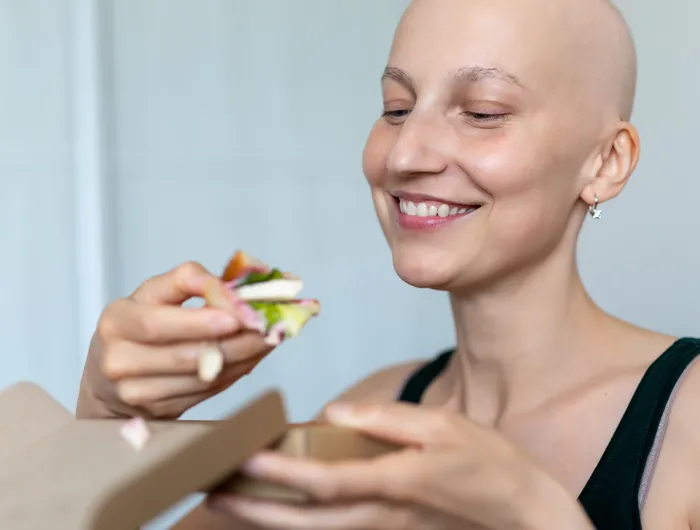
If you’re undergoing treatment for breast cancer, no evidence suggests that eating soy foods is a bad idea. (Note: It never hurts to check with your healthcare team.)
As for survivors, “it’s safe to eat soy foods after you’ve overcome breast cancer,” says Shu. “We’ve even found that a moderate intake of soy foods is linked to a lower risk of breast cancer recurrence.”
In that study, Shu’s team followed 5,033 breast cancer survivors for roughly four years. Those who consumed the most soy were about 33 percent less likely to have a recurrence or to die from their cancer than those who ate the least soy.
A word of caution: We don’t yet know whether isoflavone supplements are safe for breast cancer patients or survivors. Shu doesn’t recommend adding them to your supplement regimen (whether you’ve had breast cancer or not).
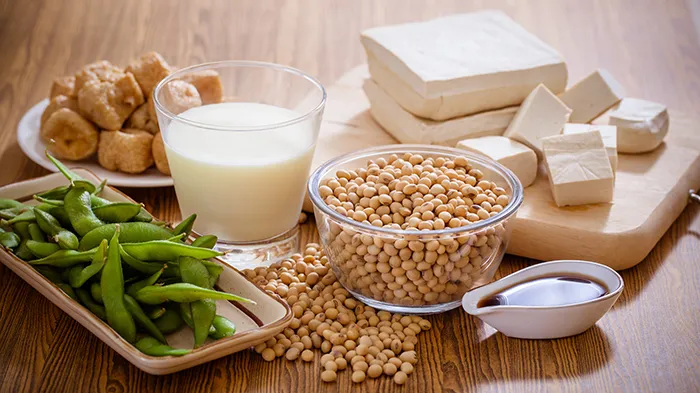
“The amount of isoflavones in supplements is much higher than what you typically get from dietary sources,” she says. It’s best to stick to soy foods like tofu, tempeh, edamame, and soy milk.
Myth: Soy feminizes men and lowers their testosterone
It’s a decades-old myth that just won’t quit…even though no good evidence shows that soy lowers testosterone, harms fertility, causes erectile dysfunction, or fuels breast growth in men.
How do we know? For starters, “there’s research that compares [the effects of] soy [versus] whey protein on testosterone levels,” said Alan Flanagan, a nutrition scientist and researcher at the University of Surrey in England, on a 2022 episode of the Sigma Nutrition Radio podcast. And meta-analyses of those studies “don’t show that soy protein alters testosterone levels.”
For example, an analysis of 38 clinical trials that looked at men’s isoflavone intake from soy foods and supplements found no impact on levels of testosterone or estrogen in their blood. The hormone levels didn’t even budge in men who consumed an amount of isoflavones roughly equal to what they’d get from more than three servings of soy foods a day. (Note: Two of the researchers who conducted the analysis disclosed ties to the soy industry.)
What about male fertility? Only a few studies have tested soy’s impact, but their findings don’t raise any alarms.
In one, 32 young men took a milk protein supplement, a soy protein supplement high in isoflavones, and a soy protein supplement with almost no isoflavones—each for two months at a time. None of the supplements affected the men’s sperm concentration, count, activity, or structure, though the authors acknowledge that longer studies are warranted.
But even if soy doesn’t alter men’s hormones or fertility, could isoflavones still “feminize” them by binding to their estrogen receptors?
It’s unlikely. The best evidence doesn’t show a link between soy intake—even at several servings a day—and erectile dysfunction or breast tissue growth.
Myth: Soy infant formulas and soy foods don’t support children’s growth
Do you need to be concerned about soy and its phytoestrogens for growing children? And what about the evidence in infants versus older kids and adults?
Let’s get one thing clear from the jump: In healthy children of all ages, soy foods can be part of a diet that promotes their physical and cognitive growth.
“I think there’s a tendency to overthink soy exposure in children,” says Margaret Adgent, a research associate professor and pediatric epidemiologist at Vanderbilt University School of Medicine. “If a child is eating a varied and well-balanced diet, soy foods are a reasonable source of protein that should pose minimal risk while also providing the benefits of a diet higher in plant-based foods.”
Another plus: Soy intake doesn’t appear to affect the onset of puberty, according to an analysis of eight studies that included 3,555 children. Four of those studies even tracked children who had been fed soy formula as infants.
In fact, adults who were fed soy formula in infancy appear to have similar heights, weights, and education levels as their peers who were given cow’s milk formula. That’s not surprising, though, since “milk-based and soy-based formulas sold in the US are required to be quite similar, nutritionally speaking,” says Reed Mangels, a registered dietitian specializing in plant-based nutrition.
Syda Productions - stock.adobe.com.
That said, soy formula and dairy formula have a few notable differences:
Phytates. “Substances in soy—mainly phytates—can reduce the absorption of minerals like calcium and phosphorus,” notes Mangels. “They aren’t as well absorbed from soy-based formulas.”
Phytates aren’t a big deal for most babies, but premature infants have greater needs. That’s why preemie formulas aren’t made from soy.
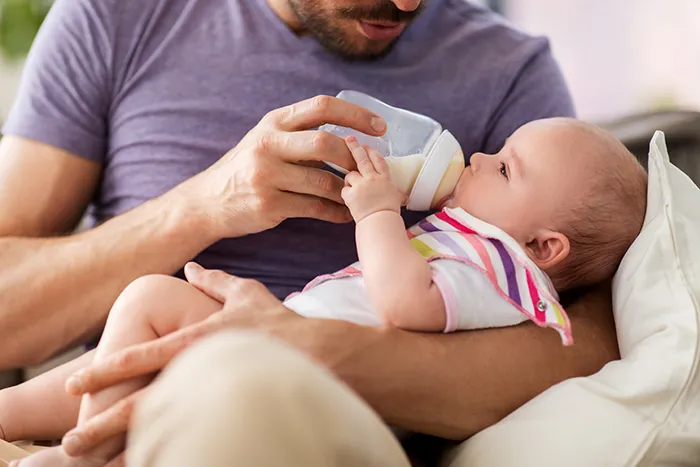
Granted, breastmilk is the ideal food for infants in most circumstances, says Mangels. But if that’s not possible—and you want to raise your child exclusively plant-based—then soy formula is the only safe vegan alternative. (Pediatricians may also recommend soy formula for babies who can’t digest dairy formula due to rare metabolic disorders.)
Phytoestrogens. Let’s say you’re choosing between soy and dairy formulas for your baby. One reason to skip soy: Its phytoestrogens “could pose subtle developmental risks,” says Adgent, who notes that infants and children are more sensitive to estrogen-like compounds than adults.
“An infant who is exclusively fed soy formula can be exposed to high levels of isoflavones—far higher than what an older child or an adult gets from soy foods as part of a varied diet,” she says.
While an adult might consume 1 milligram of soy isoflavones per kilogram of body weight in a day from a few servings of soy foods, a baby fed soy formula could be getting 4 to 9 mg per kilogram a day. That translates to a 1,000-fold higher estrogen-like exposure in soy-formula-fed infants compared to infants fed breastmilk or dairy formula.
To help understand what that higher exposure means, Adgent’s research team tracked the growth patterns of the reproductive organs of 410 infants over six to eight months. In baby girls fed soy formula, “the growth pattern of the uterus looked slightly different from that of girls fed cow’s milk formula,” she notes.
Why might that be? It turns out that reproductive development starts well before a baby is born and continues through early infancy—a window of time known as “minipuberty.”
“During this window, we think that sex hormones like estrogen may play a role in organizing some aspects of reproductive biology,” Adgent explains. “But we don’t know how sensitive minipuberty may be to estrogen‑like exposures like soy isoflavones.”
Adgent’s findings in baby girls who were fed soy formula suggest that the developing uterus may respond to soy phytoestrogens, but it’s not yet clear what, if anything, that means for reproductive health later.
One possibility: The slight shift in uterine growth patterns could explain a potential link between soy formula intake in infancy and worse menstrual pain later, though Adgent cautions that there’s not enough evidence to connect the dots. To find out if soy formula causes period pain, we’d need larger, longer studies, she says.
The good news: In boys fed soy formula, “we didn’t find differences in early male reproductive development.”
Adgent’s bottom line: If soy formula is the only option for your newborn, don’t fret. “You need to do what works for you. Having a well-fed baby is the highest priority.”
As for older kids, “my own children eat soy products on occasion, and I don’t give it a second thought.”
CSPI heavily relies on our grassroots donors to fuel our mission. Every donation—no matter how small—helps CSPI continue improving food access, removing harmful additives, strengthening food safety, conducting and reviewing research, and reforming food labeling. We don't take donations from corporations, and our flagship publication, Nutrition Action, doesn't run any ads. That means that everything we do is fiercely independent and unbiased from any bad actors, no matter how powerful. To help keep this online content 100% free, consider donating today to support CSPI.