Mushrooms are having a moment. Whether you’re looking for some fungus for your gut, a shroom to turn your white blood cells into “stronger and more efficient fighters against diseases,” or a “happiness booster” that also sharpens your focus, mushroom companies have a pill, powder, coffee, or gummy for you. Or so they say. Here’s what the evidence shows.
“Natural” fixes for common problems
“Mushroom supplements offer a natural way to support energy,” says Hamilton’s, which sells mushroom tinctures and powders for all sorts of complaints, including one blend you can add to your morning coffee.
But coffee is just as natural as mushrooms. And why pay for mushroom supplements when actual mushrooms are at least as natural as the powders and pills?
“There’s this interest in trying to get the most out of every bite, and added powders fit into that ethos,” says Meghan Laszlo, a registered dietitian who works with cancer patients at Cedars-Sinai Medical Center in Los Angeles.
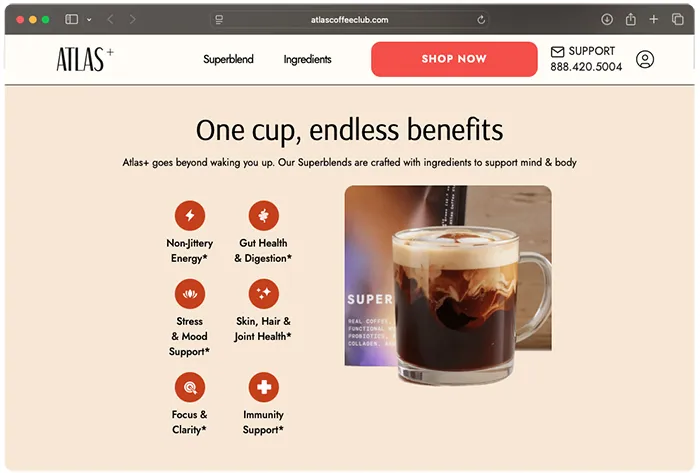
That’s the dream—a small change to your morning coffee routine that will fix health problems and keep you focused and energized all day long.
atlascoffeeclub.com.
But companies’ sweeping promises should give you pause. “When there are a lot of different claims about how many diverse benefits a product could have, it’s claiming to be a panacea,” says Laszlo. “You have to stop and look and say, ‘Okay, where are these claims coming from? Is there any evidence to support them?’”
Other experts agree. “You know the Neighborhood of Make-Believe from the children’s television show ‘Mister Rogers’ Neighborhood,’ where you could let your imagination go?” asks Pieter Cohen, an associate professor of medicine at Harvard Medical School. “That’s where the supplement manufacturers live when it comes to promoting their mushroom supplements.”
And many manufacturers encourage your imagination to go pretty far. That’s because they aren’t allowed to say that their products will treat or prevent a disease, but they can say that they support the body’s structure or function. So “treats ADHD” is a no-no. But “supports focus”? All good.
(Other mushroom marketing claims to take with a grain of salt: “functional” and “medicinal.” Those buzzwords on supplements have no legal definition, so they don’t mean much.)
Claims aside, supplement companies also don’t have to disclose their manufacturing process. So you may not know what’s in that “mushroom extract”...or if it's as "natural" as the companies would have you believe.
“Are companies just drying out the mushroom and cutting it up?” Cohen asks. “Or are they extracting some chemical from it? Whatever they’re doing can have so many different effects on the composition of the final product.”
What’s more, supplement makers are supposed to follow “good manufacturing practices” to make sure that what’s inside the bottle matches what’s on the label and that the supplement is free of contaminants like pesticides or heavy metals. But they don’t have to prove that they did that.
“That means the consumer has no idea what they’re putting in their mouth,” says Cohen.
Can mushroom coffee help with cognition or energy?
“Sip smarter. Not harder,” encourages mushroom-coffee brand Shroomi, which offers a blend for “morning clarity” that promises “improved mental clarity, enhanced productivity, long term brain health and energy!”
An 8 oz. cup of the brewed mushroom-coffee blend contains 80 milligrams of caffeine—roughly what you’d get in a regular cup of coffee—along with extracts from lion’s mane, a mushroom that Shroomi says “helps support memory, focus, and mental clarity.”
Will that deliver “the added brain boosting benefits of functional mushrooms” that Shroomi promises? At $37 for a 10 oz. bag (which makes 24 servings), it better. (Spoiler: It doesn’t.)
Lion's mane and chaga to improve brain function?
Only a few small studies have tested lion’s mane’s ability to enhance cognition. In the largest clinical trial on healthy people, researchers randomly assigned 43 adults to take 1,800 mg of lion’s mane or a placebo, then had them take seven tests of attention and memory an hour later. (A serving of Shroomi’s has about 290 mg of lion’s mane.) Those given lion’s mane performed better on just one. How much better? They responded, on average, about one-twentieth of a second more quickly. Is that going to make a big difference in real life? Not likely.
While the evidence on lion’s mane is thin, chaga (another common mushroom in alt-coffees) has even less going for it. In fact, we couldn’t find a single brain-health trial of chaga in people in a peer-reviewed journal.
Beyond the lack of evidence for mushrooms as brain-health heroes, “what’s wrong with coffee?” Laszlo asks. “There’s a lot of misunderstanding about coffee. But it seems to be cancer protective and potentially has some other benefits.”
Some people who make the switch from coffee to mushroom drinks say that they feel less tired and more focused during the day. But that could simply be because many mushroom drinks have little or no caffeine, which might make it easier for them to get a full night’s sleep.
Mushroom gummies with turkey tail and maitake for your gut health?
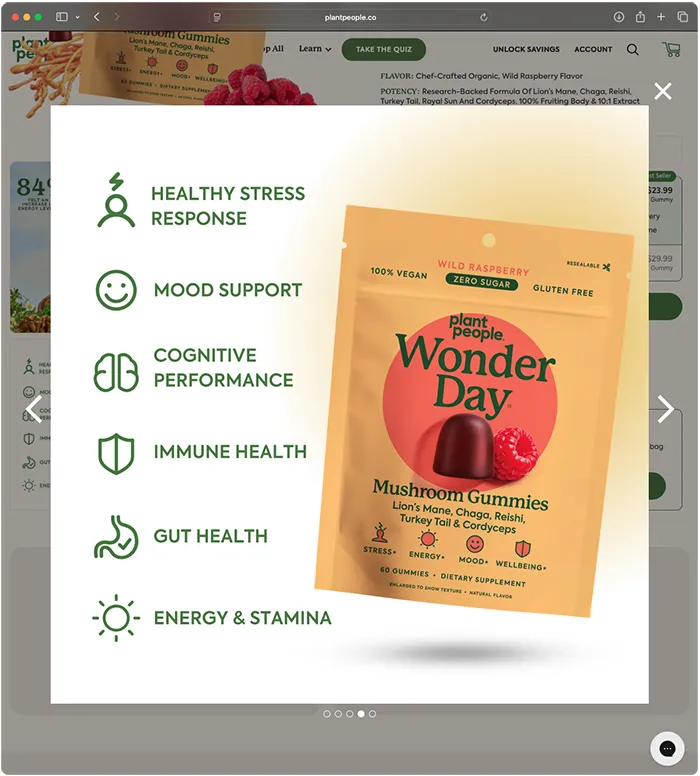
“Nourish your gut microbiome with our premium digestive wellness supplements,” says Plant People, who promise that their mushroom gummies—a 30-day supply will set you back $30—“support healthy gut microbiota.”
plantpeople.co.
The evidence? Pretty unimpressive. Plant People’s Wonder Day Mushroom Gummies contain turkey tail and maitake mushrooms. In a test-tube study, when researchers treated a culture of cells that resembled the human gut microbiome with a compound found in turkey tail mushrooms, they saw higher levels of “good” bacteria like Lactobacillus and lower levels of “bad” bacteria like Clostridium, Staphylococcus, and Enterococcus compared to a control compound.
While the meaning of those lab results isn’t totally clear, the following year, a randomized trial of healthy people who took the same turkey tail compound for two months didn’t find meaningful changes to their gut microbiome. (Both turkey tail studies were partly funded by supplement companies.)
As for maitake, no peer-reviewed clinical trials that we could find have looked at its effects on the gut microbiome.
But there is at least one reason to be excited about mushrooms—that is, the actual shiitakes, portobellos, or other mushrooms in your sauté, soup, or salad—for gut health. “They contain beta-glucans, a type of soluble fiber that helps contribute to gut microbiome diversity,” explains Laszlo.
Of course, it’s hard to say how much beta-glucan is in any given mushroom supplement (unless the manufacturer lists it on the label).
Instead of supplements, your best bet to encourage a diverse gut microbiome is to eat a variety of fiber types, says Laszlo. You can do that by loading up your plate with plenty of whole plant foods: vegetables, whole grains, nuts, seeds, beans, lentils, and, of course, mushrooms.
Hormone balancing mushroom powders?
“Our commitment is to empower women by providing access to the latest research and comprehensive resources in women’s health,” says the website of YLVA Blends, whose mushroom coffee is designed to “gently support hormonal balance.”
“I think that any supplement claiming to promote hormonal balance should raise a red flag,” Laszlo warns. “Balance between what and what?”
A few studies in animals suggest that some mushroom extracts may affect testosterone levels or insulin resistance. But it’s far too early to say whether that matters for people.
Puberty, pregnancy, menopause, stress, and some prescription drugs can all cause fluctuations in some hormones. But unexpected changes might be a sign of a serious health problem. That’s worth a conversation with your healthcare provider, not an online order of some unproven (and expensive) supplement.
Reishi mushrooms for your immune system?
Mushroom supplement company MUD\WTR claims that the reishi mushrooms included in its coffee “support a healthy immune system.”
Here we go again. If your supplement can’t legally promise to prevent the common cold or other infections, just make a vague immunity “support” claim on your website, ads, or labels. But does MUD\WTR live up to even that low bar?
Like many mushrooms, reishi show some promise in test-tube and animal studies. For example, in one study, fish fed a protein that comes from the mushrooms were better able to fight off viral infections than fish fed their normal diet. But we couldn’t find any clinical trials that have tested reishi’s ability to keep healthy people from getting sick.
More research is needed
Are mushroom coffees and supplements worth buying?
The evidence so far isn’t enough for Laszlo. “I have an evidence-based practice,” she says. “I think the animal and test-tube studies are interesting, but I would never suggest a patient follow something that’s shown in lab animals without first testing it in humans.”
Why not? “We don’t know how the study results might be different when they’re actually done in humans,” Laszlo points out. In fact, more often than not, findings from animal studies don’t translate into successful drugs for people.
But good human studies of mushroom supplements may not be just around the corner.
That’s because supplement makers have no reason to fund rigorous clinical trials of their products, Cohen points out, when they’re already cashing in without doing the research. After all, they can make “structure-or-function” claims that their supplements “support cognition” or “support the microbiome” with little oversight by the FDA.
Bottom line
Despite the hype, the evidence to back up sweeping claims for mushroom coffee and mushroom supplements comes up short. If you want to try them, be our guest. Just don’t expect enhanced focus, balanced hormones, or a future without colds or flu.
CSPI heavily relies on our grassroots donors to fuel our mission. Every donation—no matter how small—helps CSPI continue improving food access, removing harmful additives, strengthening food safety, conducting and reviewing research, and reforming food labeling. We don't take donations from corporations, and our flagship publication, Nutrition Action, doesn't run any ads. That means that everything we do is fiercely independent and unbiased from any bad actors, no matter how powerful. To help keep this online content 100% free, consider donating today to support CSPI.