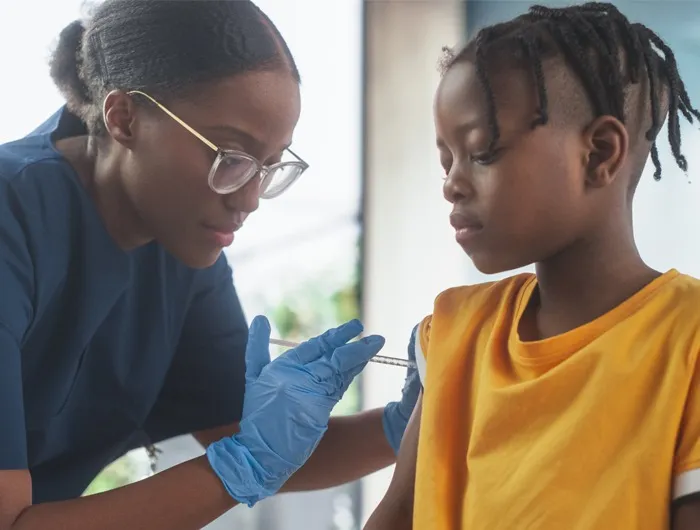
A CDC report from 2024 says that, among kids born in the United States between 1994 and 2023, routine childhood vaccinations have or will prevent an estimated 508 million cases of illness, 32 million hospitalizations, and 1,129,000 premature deaths from vaccine-preventable illnesses during their lifetimes. But changes to the childhood vaccine schedule could undermine those health benefits. Here’s what you should know about what the schedule is, how following it helps save lives, and why we know the schedule is safe.
What is the childhood vaccine schedule?
The childhood vaccine schedule is a tool that parents and doctors use to make decisions about when to vaccinate children. Although the CDC sets the schedule based on advice from its Advisory Committee on Immunization Practices, each state can establish its own vaccine requirements for school-age children. The schedule gives advice on the timing of vaccinations that are important and appropriate for kids, starting at birth all the way up to adulthood.
Before being changed in January 2026, the schedule recommended vaccines against 14 dangerous diseases, including respiratory syncytial virus (RSV), hepatitis A and B, measles, mumps, rubella, chicken pox, and polio. Now, six of those vaccines are recommended only for some children at higher risk of disease. These six vaccines are for RSV, hepatitis A and B, dengue, and two vaccines against different types of meningitis. The changes weren’t prompted by fresh scientific evidence and weren’t the result of the typical process for important decisions related to the schedule. Vaccine experts worry that removing some vaccines from the recommended schedule will cause confusion, depress vaccination rates, and put people at unnecessary risk of disease.
(Heads up: In a previous paragraph, we linked to the vaccine schedule provided by the American Academy of Pediatrics (AAP), a professional organization for pediatricians, due to the worrisome and unprecedented changes to the CDC’s vaccine schedule.)
Why bother with vaccination, given most of those diseases are rare in the US? The reason they’re rare is because the childhood vaccine schedule is a success story. If it weren’t for those vaccines, many more of us would likely know someone who’s suffered from serious illnesses like polio, measles, or whooping cough.
What’s more, some vaccines work best when nearly everyone gets them. Before the pandemic interrupted routine healthcare, 95 percent of age-eligible children in the United States had received all recommended doses of three key vaccines: the combination vaccination against measles, mumps, and rubella (MMR), varicella (which protects against chicken pox), and DTaP (which protects against diphtheria, tetanus, and pertussis). Unfortunately, that number dropped to between 92 and 93 percent in 2025, which opens the door for some of these diseases to come surging back.
That drop in vaccination prevalence may not sound like much, but, for example, 95 percent of a population needs to be vaccinated against measles to keep the disease from spreading because the disease is so infectious. And that’s why we’re seeing measles outbreaks now. In 2018, there were just 381 cases of measles in the United States. In 2025, there were 2,242 cases.
Why does the childhood vaccine schedule include so many vaccines for infants?
One concern parents often have about the childhood vaccine schedule is that these vaccines are suggested for infants (children under the age of one year). Parents may feel that their infants are too young to be susceptible to so many diseases or think that infants’ immune systems can’t handle all those shots. But there are good reasons to vaccinate children in the first year.
Charlotte A. Moser, co-director of the Vaccine Education Center at the Children’s Hospital of Philadelphia, explains that infants are exposed to bacteria and viruses from the moment they’re born, though they do have some protection from their birthing parents. “Right after birth, they have some maternal antibodies that they got through the placenta,” says Moser. “And if they’re being breastfed, they’re getting some antibodies through breast milk. That’s called passive immunization.”
But that protection doesn’t last forever.
“Those antibodies will eventually go away because they weren't made by the child's immune system,” Moser explains. “They're borrowed immunity.” But parents can help ensure that their child has a limited gap in protection by vaccinating infants while they still have some protection from maternal antibodies.
Some parents are concerned that the vaccines might overwhelm a child’s immune system. But that’s “a misunderstanding about how our immune systems work,” says Moser. “It suggests that our immune systems aren’t capable of handling all those vaccines at once, when the reality is that our immune systems are dealing with way more than that every single day.”
Children are constantly activating their immune systems by, for example, putting a pacifier in their mouth after it falls on the floor or playing with other children who might be sick. Nothing about our world is sterile: not the food we eat, the water we drink, or the floors our kids crawl on. Our immune system is challenged, day-in and day-out, and it almost always rises to each challenge without issue. Vaccines are just a tiny fraction of that challenge.
Moser emphasizes that vaccines take a lot of risk out of childhood, though she understands why parents are concerned. “I think parents feel out of control because they don't necessarily know what's in vaccines,” she says. “But vaccines actually offer them a level of control that they don't have with the bacteria and viruses that their kids are naturally exposed to.”
Getting kids vaccinated according to the schedule is not only the best option for most kids’ health, but it can also make life easier for parents and kids alike. When kids receive more than one vaccine in a single office visit (or vaccines against multiple diseases in a combination vaccine), parents save time and money. And it might even be less traumatic for the child than returning over and over again for multiple visits, which the schedule is designed to minimize.
The childhood vaccine schedule is safe
The process to ensure the childhood vaccine schedule’s safety is rigorous and thorough, though there are limits to what we can test in clinical trials. For example, there will likely never be a trial that evaluates the entire vaccine schedule at once by comparing a group of kids who were randomized to receive all their vaccines on time to another group receiving vaccines on a delayed schedule (or not at all). Why not? “There’s no ethical way to do that study,” Moser explains. “We know vaccines work, so we would be withholding protection from children who were randomly assigned to the delayed group.”
On top of that, the number of potential combinations of vaccines is extremely high, so every specific combination can’t feasibly be tested. You’d have to study an enormous number of people to completely eliminate any risk of adverse outcomes from each combination. With the evidence we already have that vaccines are safe, there’s no reason to do that type of study.
Instead of testing the vaccine schedule in its entirety, each newly approved vaccine is tested along with the vaccines already recommended for that age group, to ensure that they’re safe and effective in combination. For example, when the hepatitis B vaccine arrived, it was tested with and without the polio and pertussis vaccines. The researchers found that there were no differences in the immune response to the vaccine when it was administered with others, and that there were no adverse events associated with giving the vaccines at the same time.
Because there are limits to what we can study in clinical trials, the FDA and CDC don’t stop the work of monitoring and evaluating vaccines for safety when new vaccines get added to the schedule. “It’s not like a vaccine gets put on the schedule and then, okay, done, check, move on,” Moser points out. “There is continuous monitoring,” and not just by the FDA and CDC.
Health care providers, patients, and family members of patients who believe that someone had a negative reaction to a vaccine can file a report with the Vaccine Adverse Event Reporting System. The Vaccine Safety DataLink collects information from electronic health records to monitor vaccine safety. And the Department of Defense, Department of Veterans Affairs, and the Indian Health Service all monitor vaccine safety in their key populations. That’s why vaccine experts are not worried about any cumulative damage from the entire vaccine schedule: They trust that the surveillance systems are robust.
The vaccine schedule offers the right vaccines at the right times for almost every kid
There are some relatively uncommon situations in which a different vaccine schedule might be the right choice. For example, children with chronic conditions or who take medication that weakens their immune system may need additional doses of some vaccines, or even a different type of vaccine. But for most children, the recommended schedule is a great fit. In fact, Moser points out that parents who delay vaccines or have them given to their children outside the windows suggested by the official schedule are effectively making up their own schedule that hasn’t been tested for safety by anyone. “If your concern is that the schedule isn’t well tested enough, then why would you want to go and give your child vaccines on a schedule that you’ve made up?”
Delaying the hepatitis B vaccine leaves newborns vulnerable to chronic disease
You may never have thought about hepatitis B before, but there’s a good chance that you’ve seen it pop up in your newsfeed in recent weeks as some people question—and experts seek to defend—the current hepatitis B vaccination schedule.
Hepatis B, a viral infection that can damage your liver, is particularly dangerous for young children. About 90 percent of infants who are infected before their first birthday and 30 percent of children who are infected between ages 1 and 5 will go on to develop chronic hepatitis B infection. And up to 25 percent of people with a chronic infection will develop chronic liver disease, which can include cirrhosis, liver failure, and liver cancer.
Hepatitis B can be transmitted through sexual contact or by sharing contaminated needles, but those aren’t the only ways it spreads. Infants are also vulnerable to hepatitis B infection because it can be transmitted during childbirth or while an infected person is caring for a newborn. The virus lives in blood (or other bodily fluids that sometimes contain blood, like saliva) and can survive for several days on surfaces and objects. Just 50 percent of people with hepatis B know they have it, so infants could easily be unknowingly exposed.
What about testing parents and vaccinating only the infants born to those with hepatitis B, as some have proposed? That solution is imperfect because infants often spend time around other people who may have hepatitis B, like extended family members. And even though the CDC recommends that all pregnant people be screened for hepatitis B, only about 88 percent of pregnant people are actually getting that screening.
In fact, the hepatitis B vaccine was introduced in 1981 but initially only recommended for babies born to what were considered “high-risk” parents, including those known to have hepatitis B, healthcare workers, and intravenous drug users. But that system proved to have limited success as infants were still getting infected with hepatitis B. In 1991, the vaccine was recommended for all newborns, resulting in a 99 percent drop in new cases of hepatitis B in children.
Despite that progress, at a meeting of CDC’s Advisory Committee on Immunization Practices on Dec. 5, 2025, committee members voted 8 to 3 to recommend delaying the initial dose for at least two months after birth (although the birth dose is still recommended for babies born to people who test positive for hepatitis B). Vaccine experts and pediatricians agree that the change endangers children. In addition to the potential for an infant to be exposed before two months of age, delaying vaccines is linked to not being up to date with all the vaccinations on the childhood schedule. Translation: A delay in getting vaccinated may mean not getting vaccinated at all.
What’s more, there’s no reason to question the safety of the hepatitis B vaccine in the first place. The Vaccine Integrity Project at the Center for Infectious Disease Research and Policy (CIDRAP) at the University of Minnesota recently released a review of more than 400 studies and reports related to the hepatitis B vaccine. “After extensive review, we did not discover safety or effectiveness data that support delaying the choice parents have to vaccinate their newborns against hepatitis B,” said CIDRAP’s director, Michael Osterholm, in a press release. “Instead, it showed that a delay will needlessly endanger the health of America’s children, putting more of them at risk of [hepatitis B] infection.”
The bottom line: Vaccines save lives
The childhood vaccine schedule is safe, effective, and shouldn’t be compromised. You can be confident that vaccinating your child according to the full schedule will keep them as safe and healthy as possible. Talk to your doctor if you have any questions.