How to use Nutrition Facts: 8 confusing examples, explained
Drazen - stock.adobe.com.
Nutrition Facts look simple, but seasoned label readers know things can get complicated. Spend enough time reading—or comparing—food labels, and you’re likely to wind up confused at least once in a while. (We’ve been there.) Here are answers to a handful of tricky questions about calories, sugar, alcohol, and more, plus a look at some sources of serving-size confusion.
This article comes fromNutrition Action. We don’t accept any paid advertising or corporate or government donations. Any products we recommend have been vetted by our staff and are not advertisements by the manufacturers. They’re just healthier foods we think you’d like to know about!
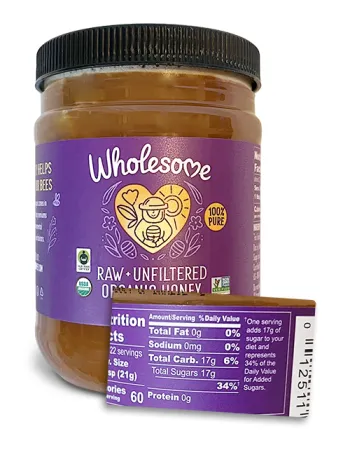
When honey, maple syrup, brown sugar, or another sugary sweetener is an ingredient in a cereal, granola bar, yogurt, or other food, its sugar is always included in the grams of “added sugars” line on the food’s Nutrition Facts label. So why is that line largely blank on the label for Wholesome Organic Honey? The label lists 17 grams of “total sugars,” but the line below it—the one that’s supposed to show how many grams of “added sugars” are included in that total—is empty...except for a “34%.” What gives?
Disclosing the grams of “added sugars” on Nutrition Facts labels for sugary sweeteners is voluntary, which explains why the number is often missing. The backstory: A label for grams of “added sugars” on honey or maple syrup, industry lobbyists argued years ago, would make it look like companies had added more sugar to their honey, syrup, etc. So the Food and Drug Administration lets those sweetener labels use a mostly blank line if they want to. They only need to include the “% Daily Value” (DV), which tells you how much of the 50-gram recommended daily limit for added sugars you’re getting in one serving.
But all of a sweetener’s sugars count when they calculate the % DV. That’s why the Wholesome Organic Honey label lists 34% DV. As the label’s footnote explains, “One serving adds 17g of sugar to your diet and represents 34% of the Daily Value for Added Sugars.”
What else you should know about added-sugars labeling
You could also see a largely blank “added sugars” line on the Nutrition Facts label for any white or brown sugar, coconut sugar, agave syrup, etc. Just don’t be fooled by that. Whether sugars come from honey, maple syrup, agave syrup, or sugar, they all count as “added sugars” in your diet, says the FDA.
Does oil spray have zero calories?
Lindsay Moyer - CSPI.
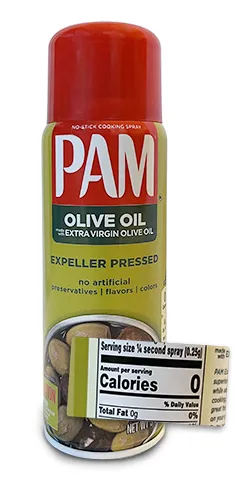
PAM Olive Oil No-Stick Cooking Spray “delivers superior non-stick performance while adding zero fat to your cooking,” according to the can. And the Nutrition Facts label lists 0 grams of fat—and 0 calories—per serving. Other cooking oil sprays do the same.
But oil is oil. PAM and the others aren’t selling you a zero-fat version. It’s a matter of rounding. The FDA’s rules say that a serving of cooking oil spray is a mere 1/4 gram. Since the spray is almost pure oil, that’s equal to roughly 1/4 gram of fat, which has about 2 calories. But anything below 1/2 gram of fat or 5 calories rounds down to zero, say the feds.
Of course, that doesn’t mean you end up with no fat or calories. A can of PAM dispenses its 1/4-gram serving of oil in just a “1/4 second spray.” That’s pretty fast. If it takes you, say, four seconds to fully coat your pan, you’re looking at an estimated 4 grams of oil and 35 calories. That’s fine—olive oil is healthy—but it’s always good to know what you’re getting.
What else you should know about rounding on Nutrition Facts
Sugar’s rounding on the Nutrition Facts label works similarly. If a food contains less than 1/2 gram of sugar per serving, it rounds down to 0 grams on the Nutrition Facts label. That explains why a seasoning blend with a tiny, 1/4-teaspoon serving size—like McCormick Grill Mates Brown Sugar Bourbon Seasoning—doesn’t even have an entry for sugar on its Nutrition Facts label even though it contains two kinds of sugar plus molasses. Does that matter? Not really. If you’re using a typical serving, the amounts are trivial.
Don’t beans have more vitamins and minerals than the Nutrition Facts show?
Lindsay Moyer - CSPI.
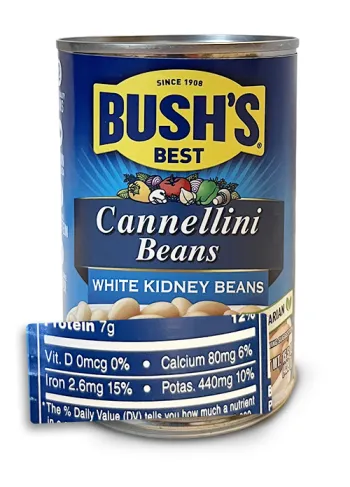
A can of Bush’s Cannellini Beans lists the amount of just four vitamins and minerals (other than sodium) on its Nutrition Facts label: vitamin D, calcium, iron, and potassium.
But if you’ve been reading along in Nutrition Action, you know that beans are vitamin-and-mineral superstars: We’re talking about not just a nice supply of iron and potassium, but also magnesium, zinc, copper, and folate.
So why aren’t they all listed? On most Nutrition Facts labels, the FDA only requires vitamin D, calcium, iron, and potassium. They’re a priority because shortfalls of the four are (1) relatively common and (2) linked to major health problems. (If a food adds—or makes a claim about—any other vitamin or mineral, it must be listed on the Nutrition Facts label. And any label can show others, but it’s entirely voluntary.)
That’s why, if you don’t see another vitamin or mineral listed, you shouldn’t assume the food has none of it, especially if it’s known to be a natural source (like, say, the vitamin C in strawberries).
And it’s why, if you use an app like MyFitnessPal to track your food intake, your daily totals for some vitamins and minerals may be underestimates.
Why do some alcoholic drinks have a Nutrition Facts label and others don’t?
Lindsay Moyer - CSPI.
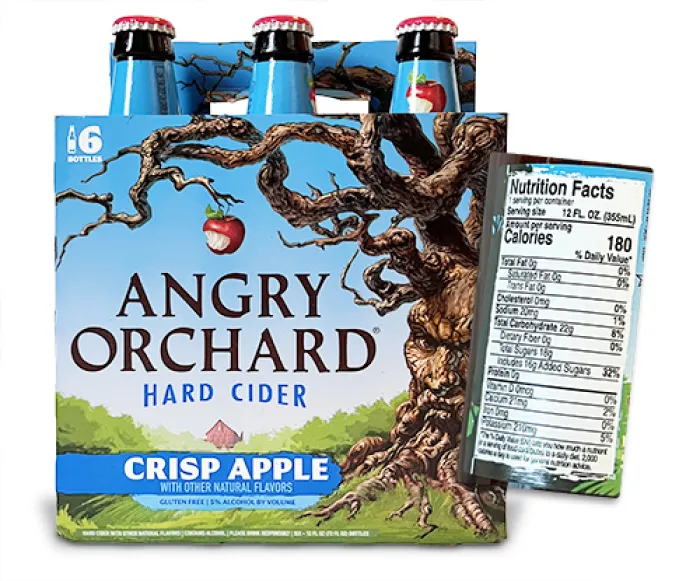
Angry Orchard Crisp Apple Hard Cider comes with clear Nutrition Facts that list calories, added sugars, sodium, and everything else. Ditto for many hard seltzers and wine coolers. But most beers, wines, and hard liquors either list only a few numbers (calories, carbs, fat, protein) or nothing at all. Why the split?
A small group of drinks (most hard seltzers, wine coolers, and hard ciders) are subject to the FDA’s labeling rules, so they must have Nutrition Facts. But most alcohol isn’t regulated by the FDA, so nutrition info isn’t required. (Some brands include it voluntarily. We’ve spent more than 20 yearspushing the government to quit dragging its feet on improving those rules. Sigh.)
What can you do? To find out calories or other info about alcoholic drinks that have no Nutrition Facts, you can try checking the company’s website, asking their customer service department, or checking out our chart of calories in many popular drinks.
What else you should know about missing Nutrition Facts
Most beverages and foods—other than fresh whole fruits and vegetables—must have a Nutrition Facts label. One big exception: the US Department of Agriculture’s rules let companies skip a Nutrition Facts label on whole cuts of meat and poultry if the grocery store posts the information for the most popular cuts on a poster or brochure in the store. (Ground or chopped meat must have a label on the package, though.)
More missing numbers: Even if a food or drink has a Nutrition Facts label, it may not include everything you might want to know. Caffeine, for example, isn’t required. Some companies list the caffeine content of their products elsewhere on the package or on their website, or they provide the information if you ask customer service. When in doubt, check our caffeine chart.
4 sources of serving-size confusion on Nutrition Facts labels
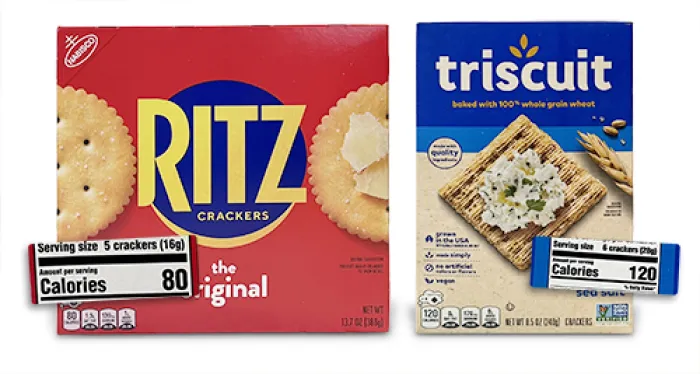
Ritz or Triscuits? Mini bagels or regular? Decisions, decisions. If you’re like many shoppers, comparing the Nutrition Facts helps you pick. But because of unequal serving sizes, those comparisons may not always be apples to apples. Here are some to look out for.
Mini bagels and more
Lindsay Moyer - CSPI.
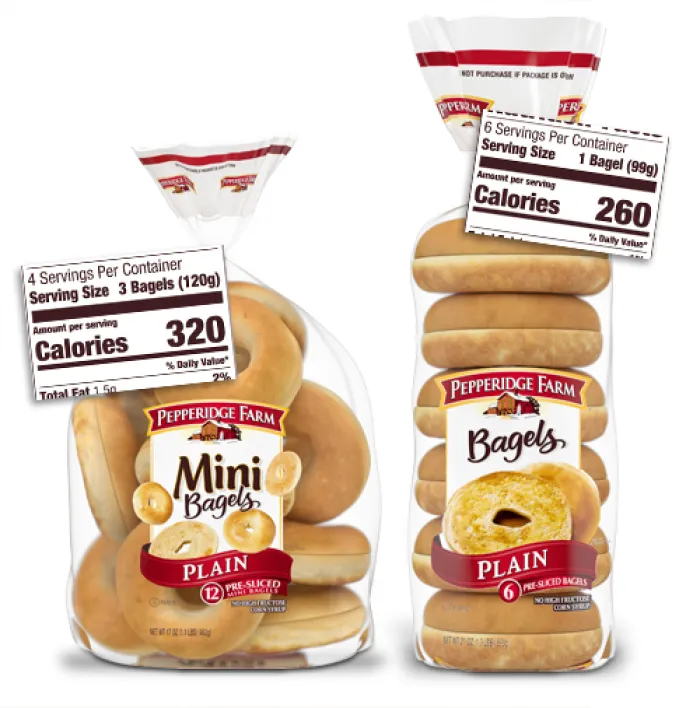
Despite what the big numbers on the Nutrition Facts labels seem to be saying, a Pepperidge Farm Plain Mini Bagel doesn’t have more calories than a Pepperidge Farm full-size Plain Bagel. Those 320 calories are for three minis.
That’s because mini bagels must follow the same labeling rules as full-size bagels. They have to list Nutrition Facts for the number of bagels that comes closest to 110 grams. (In this case, that’s three 40-gram minis.) Why so much? Simple. The average bagel keeps getting bigger…and serving sizes reflect what Americans typically eat, not necessarily what we should eat.
The bottom line: Mini bagels usually come with Nutrition Facts for a multiple-bagel serving. But if you’re buying them because you want a petite, one-mini portion, divide the calories (and the sodium, etc.) by the number of bagels in a serving.
What else you should know about serving sizes for “mini” foods
Because ice cream bars—and popsicles, ice cream sandwiches, and other “frozen novelties”—follow similar rules, some mini treats list a two- or three-bar serving.
Cookies
Lindsay Moyer - CSPI.
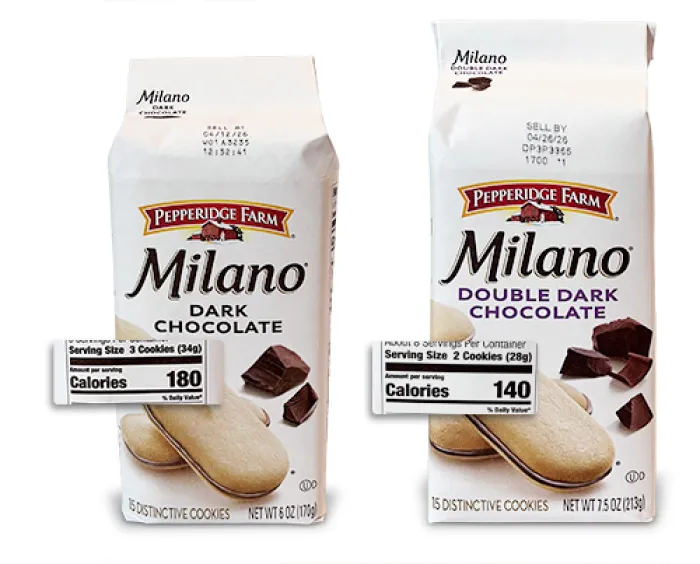
Pepperidge Farm Milano Dark Chocolate cookies have 180 calories per serving. Milano Double Dark Chocolate cookies have 140. If you’re going to eat a couple of cookies, which is the better calorie bargain? The Dark Chocolate.
It’s not a trick question. The FDA’s rules require companies to list the number of cookies that weigh closest to 30 grams. For the Dark Chocolates, which weigh 11 grams each, that’s three (60-calorie) cookies. For the Double Dark, which weigh 14 grams each, it’s two. If you only glance at the big numbers on the Nutrition Facts labels, it looks like the Double Dark Chocolate cookies have fewer calories. But if you’re looking to maximize the number of cookies and minimize the calories, the Dark Chocolates are the way to go.
What else you should know about comparing “unit” foods
Loaves of sliced bread have a similar problem. Some Nutrition Facts labels have to list numbers for one slice. Others use two, or even three, slices per serving, depending on the weight of a slice. That’s why you always need to check the number of slices before you compare one bread to another.
Granola
Lindsay Moyer - CSPI.
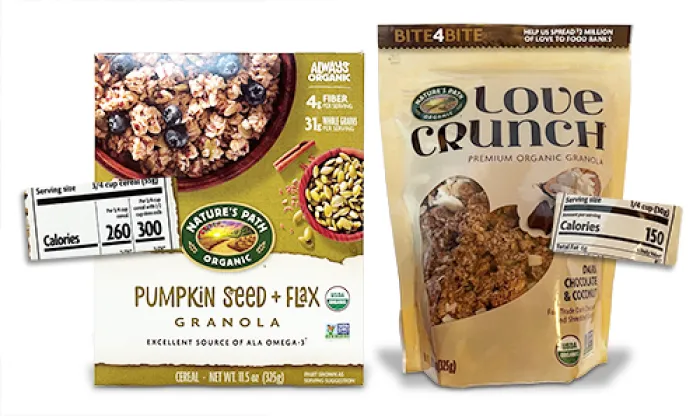
A box of Nature’s Path Organic Pumpkin Seed + Flax Granola uses a 3/4-cup serving (260 calories). But a pouch of the same company’s Love Crunch Dark Chocolate & Coconut Granola uses just a 1/4-cup serving (150 calories). What’s going on?
The pumpkin-seed granola lists Nutrition Facts for a serving of cereal, while the chocolate coconut granola lists Nutrition Facts for a serving of a snack. (The FDA’s rules for “snack” servings include “grain-based snack mixes.”) Tricky.
In fact, a larger, cereal-size serving of the chocolate Love Crunch would have slightly more calories (and more added sugars) than the Pumpkin + Flax, not less.
It’s not just Love Crunch. Some other brands, like Purely Elizabeth and Safe + Fair, also label their granola pouches with a snack-size serving. In contrast, Bear Naked and many others label their pouches with dual-column Nutrition Facts that include the cereal-size serving for a “bowl” and the smaller serving for a “snack.” That makes it much easier to comparison shop.
What else you should know about comparing cereals
Serving sizes for cereals vary widely. They can be as little as 1/4 cup...or as much as 1-1/2 cups. Why such a big range? According to the FDA, the serving size is the fraction of a cup that comes closest to weighing 40 grams (for less-dense cereals) or 60 grams (for denser cereals). For the least-dense, puffed-grain-type cereals, that number is even lower (15 grams). But what matters is how much ends up in your bowl. More than the serving listed on the Nutrition Facts label? Multiply.
Crackers
The serving sizes on the Nutrition Facts labels for Ritz (5 crackers) and Triscuits (6 crackers) look similar…but they’re not. A serving of Triscuits weighs almost twice as much as a serving of Ritz (28 grams vs. 16 grams). That makes Ritz look lower in calories (and sodium)…but it’s not.
Here’s what’s going on. Ritz lists a serving size that’s also required for saltines, melba toast, crispbreads, and other crackers “that are usually not used” as a snack, per the FDA’s rules. That lighter serving size makes sense if, say, you’re eating fewer rye crispbread crackers because you’re layering them with toppings. But if you’re snacking on Ritz, saltines, crispbreads, etc., straight from the box, they’re no different than any other cracker. So if you’re going to compare them to a typical cracker like Triscuits, double their numbers first.
And keep in mind that, health-wise, Triscuits beat Ritz hands down. They’re 100 percent whole grain; Ritz are 100 percent refined grain.
What else you should know about comparing crackers
Lindsay Moyer - CSPI.
Nordic-style whole-grain rye crispbreads like Finn Crisp or Wasa Light Rye typically bear the smaller, Ritz-size serving on their Nutrition Facts labels. That can make their grams of fiber look lower by comparison. So if you’re pitting a crispbread against a typical cracker, double the crispbread’s numbers. Ta-da! They’re a fiber standout.
CSPI heavily relies on our grassroots donors to fuel our mission. Every donation—no matter how small—helps CSPI continue improving food access, removing harmful additives, strengthening food safety, conducting and reviewing research, and reforming food labeling. We don't take donations from corporations, and our flagship publication, Nutrition Action, doesn't run any ads. That means that everything we do is fiercely independent and unbiased from any bad actors, no matter how powerful. To help keep this online content 100% free, consider donating today to support CSPI.