The healthiest nut or seed butters: 10 things to know
anaumenko - stock.adobe.com.
Stir or no-stir nut butter? Almond or peanut? Sunflower or sesame? Protein-boosted or not? Decisions, decisions. With no more than a few ingredients, most nut and seed butters are simple. But picking a healthy one isn’t always easy. Here’s what may—or may not—matter to you.
This article comes fromNutrition Action. We don’t accept any paid advertising or corporate or government donations. Any products we recommend have been vetted by our staff and are not advertisements by the manufacturers. They’re just healthier foods we think you’d like to know about!
1. To stir or not to stir?
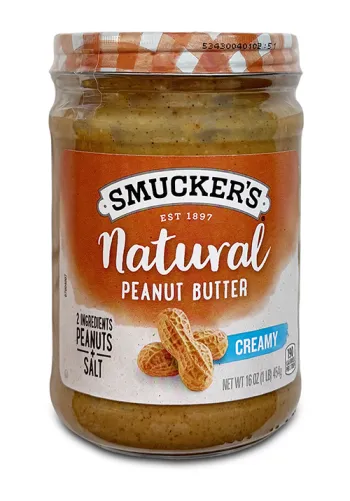
Peanuts, salt, great taste. It’s all you need.
Marlena Koch – CSPI.
Some of the healthiest nut butters have just one or two ingredients: nuts (or seeds) and maybe salt. That makes it pretty much foolproof to pick a good one. All of the fats in those need-to-stir varieties come from the nuts or seeds themselves, so you’re getting largely the healthy, unsaturated kind. And most of those butters don’t add any sugars, either.
The downside: Because their natural oils separate, you’ll need to stir before spreading.
2. Don’t want to stir? Don’t sweat it.
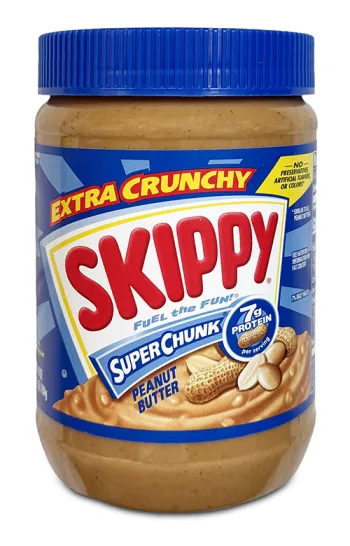
Skippy Super Chunk (an Honorable Mention) needs no stirring, and it only has a tiny bit of extra saturated fat from the oil that’s added to stop it from separating. Nice!
Marlena Koch – CSPI.
Our picks for the healthiest nut and seed butters—our Best Bites and Honorable Mentions—have no more than 3 grams of saturated fat in two tablespoons.
That lets in “stir” types (see No. 1). It also lets in “no-stir” types that add only a touch of highly saturated palm oil, coconut oil, or fully hydrogenated oil to keep their nut-or-seed oils from separating.
3. Don’t worry about ‘hydrogenated’ oil.
Those oils in the ingredient list for some no-stir peanut butters are fully hydrogenated oils (saturated fat), not the same as the infamous “partially hydrogenated” oils (trans fat) that the FDA banned years ago.
4. Should you pick peanut, almond, or cashew butter?
Does a peanut vs. almond butter match-up have a winner? Not really. Both are worthy of a Best Bite or Honorable Mention. The biggest difference hits your wallet: Almond butter costs far more than peanut butter (see No. 10).
Another plus for peanut butter: sustainability. If you’re concerned about freshwater use, it takes far more water to grow almonds than peanuts.
Healthwise, almonds have somewhat more magnesium, vitamin E, and fiber than peanuts. But those differences matter less than the benefits of both: Each has LDL-cholesterol-lowering polyunsaturated fats and a nice dose of plant protein (6 to 8 grams in 2 Tbs.).
Then there’s the less-common cashew butter, which can offer a change of pace for your taste buds and which keeps saturated fat roughly as low as peanut or almond butters do.
On the downside, cashews (and their butters) have fewer polyunsaturated fats than peanuts, almonds, or sunflower, sesame, or pumpkin seeds. So if you want to maximize your dose of LDL-lowering polys, cashew butter isn’t the best of the bunch.
5. Give seeds a chance.
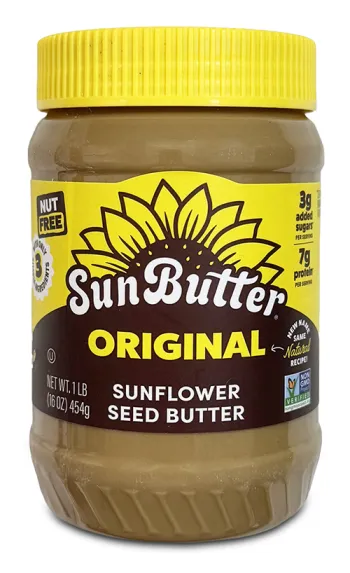
Got allergies? SunButter has no peanuts or tree nuts in its sunflower butters or anywhere in its production facility.
Marlena Koch – CSPI.
If you’re allergic to peanuts, almonds, or cashews but want a butter that still delivers healthy fats, you have options:
Sunflower. SunButter’s sunflower seed butter is not only free of peanuts and tree nuts; it’s also produced in a facility without them, says the company. Bonus: Sunflower butter has more folate, magnesium, zinc, and vitamin E than peanut butter.
Pumpkin. Don’t let its pepita-green hue deter you. Pumpkin seed is among the few kinds of butters that can match the protein (8 grams in 2 Tbs.) found in peanut butter.
Sesame. Super-savory tahini is simply toasted sesame seed butter. That’s crucial info for anyone who’s allergic to sesame (one of the top 9 allergens). But for everyone else, it’s worth a try. While you may not want to spread tahini on your sandwich because its consistency is a tad runny, you will want to use it for making dynamite salad dressings, sauces, and more.
6. Does extra protein in nut butter matter?
“Protein” varieties don’t turn peanut butter into egg whites. Skippy Protein, for example, has about 10 grams of protein in every 2 Tbs. serving, versus 7 or 8 grams in most regular peanut butters. Its protein boost from added pea protein is small.
And it probably doesn’t matter how many grams of protein come from your nut butter if your meal already has a heavy hitter like tofu, Greek yogurt, cottage cheese, or meat, poultry or seafood.
But what if you’re eating a mostly plant-based diet and want to maximize your protein from plants wherever you can? Peanut and pumpkin butters have the most protein per 2 Tbs. serving (8 grams). Cashew butter has only half that much (4 grams). Almond, sunflower, sesame, and mixed butters land somewhere in the middle.
What about peanut and almond powders like PB2 and PBFit that you prepare by mixing with a little water? Compared to regular peanut or almond butter, each 2 Tbs. serving of powder has a similar dose of plant protein (4 to 9 grams) for just a fraction of the butter’s calories (50 to 70).
That means you could eat a larger serving of PB2 or PBFit and wind up with more protein…for no more calories. Why? Powdered nut butters are made from nuts that have been pressed to remove much of their oil. Alas, that also removes some creamy texture that you might find yourself yearning for if you eat nut butter on toast or in a sandwich.
On the upside, texture doesn’t matter in a smoothie or in a bowl of oats or cereal and milk. A few spoonfuls of powder is an easy way to add some protein and nutty flavor to yours.
7. Don’t worry about sugar in unflavored nut butters.
Most big brands of nut butter are low in added sugars. Two tablespoons of regular Jif, Skippy, or Peter Pan peanut butter have just 2 grams (1/2 teaspoon) of added sugars—a low 4 percent of a day’s worth. And most sweetened varieties of SunButter Sunflower Butter have 3 grams. That’s as high as we let our Honorable Mentions go. Our Best Bites have zero added sugars.
8. Do worry about sugar in flavored nut butters.
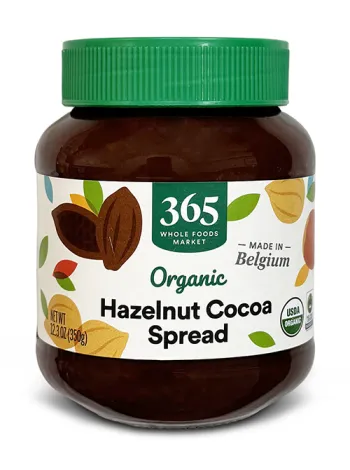
The “hazelnut” is just a health halo. Every 2 Tbs. serving of 365 Organic Hazelnut Cocoa Spread has roughly 40 percent of a day’s added-sugars limit and 60 percent of a day’s saturated-fat max.
Marlena Koch – CSPI.
Two tablespoons of many flavored nut butters have 1, 2, 3, or even 4-plus teaspoons of added sugars. Among the worst: chocolate-flavored hazelnut spreads. Nutella, for example, delivers 19 grams—that’s 4-1/2 teaspoons—of added sugars. It contains more sugar than nuts!
Plenty of others do better. Try Justin’s Chocolate Hazelnut & Almond Butter (8 grams of added sugars), Jif Peanut Butter & Chocolate Flavored Spread (8 grams), Peanut Butter & Co Dark Chocolatey Dreams (6 grams), Soom Sea Salt Chocolate Sesame Spread (6 grams), or Target’s Good & Gather Dark Chocolate Creamy Almond Butter (4 grams), which just misses an Honorable Mention.
9. Most nut butters are low in sodium.
It’s rare to find a nut butter that tops 150 milligrams of sodium (our maximum for an Honorable Mention) in a 2 Tbs. serving. But if you’re counting every milligram, head for our Best Bites, which have no added salt.
10. Like peanut butter? Save yourself some money.
A 1 lb. jar of Whole Foods Market 365 (that’s its store-brand) unsweetened peanut butter costs around $2.50. For almond butter, the cost jumps to roughly $7.50…and some other brands hit $12 to $17. Yikes.
The bottom line is clear: If you want healthy fats, great taste, and maximum savings—and you’re not allergic to peanuts—go with peanut butter. And consider a store brand, which may save you a little money, even if you don’t see it on our list of Best Bites and Honorable Mentions (we don’t have room for everything). Just compare the product to our criteria. Many basic butters fit the bill.
How nutrition compares for brands of peanut, almond, and other nut and seed butters
Best Bites and Honorable Mentions have no more than 3 grams of saturated fat in a 2 Tbs. serving. Best Bites have no added sugars or salt; Honorable Mentions can have up to 3 grams of added sugars and 150 mg of sodium.
Unflavored butters are ranked from least to most sat fat, then added sugars, then sodium. Flavored butters are ranked from least to most added sugars, then sat fat, then sodium.
Donate to CSPI today
CSPI heavily relies on our grassroots donors to fuel our mission. Every donation—no matter how small—helps CSPI continue improving food access, removing harmful additives, strengthening food safety, conducting and reviewing research, and reforming food labeling. We don't take donations from corporations, and our flagship publication, Nutrition Action, doesn't run any ads. That means that everything we do is fiercely independent and unbiased from any bad actors, no matter how powerful. To help keep this online content 100% free, consider donating today to support CSPI.
Our free Healthy Tips newsletter offers a peek at what Nutrition Action subscribers get—scrupulously researched advice about food of all kinds, staying healthy with diet and exercise, and more.