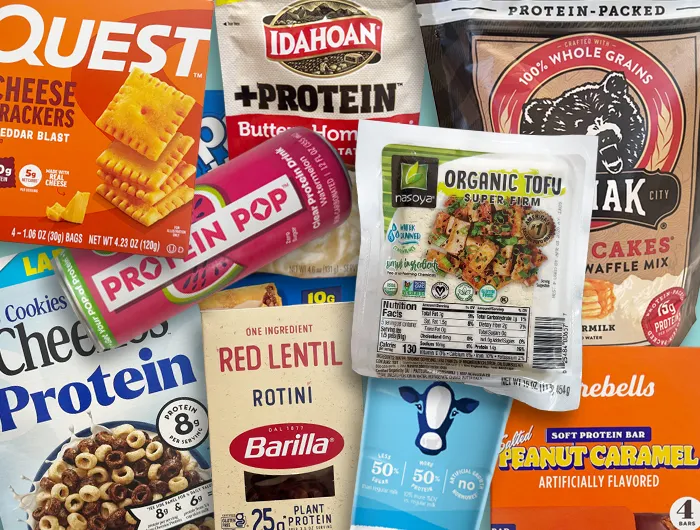
“We are ending the war on protein,” announced the new Dietary Guidelines for Americans website in January.
Huh? What “war”? Judging by the supermarket shelves that are awash in protein pastries, crackers, and cookies, protein has already won! But what kind of a victory is it if it means we’re eating more pumped-up processed junk foods?
This article comes fromNutrition Action. We don’t accept any paid advertising or corporate or government donations. Any products we recommend have been vetted by our staff and are not advertisements by the manufacturers. They’re just healthier foods we think you’d like to know about!
On the other hand, bumping up the protein in healthy foods can have upsides. Maybe we’re talking about boosting the protein of a lower-protein meal like pancakes or pasta. And if the added protein replaces fat or sugar (or other carbs), it won’t boost the overall calories.
Here’s a look at six protein junk foods, plus four healthy foods that come with extra protein. Just keep in mind that most adults in the US already eat more than enough protein, period. (The Daily Value is 50 grams.) That means any fancy protein food—even a healthy one—is unlikely to make or break your diet.
Want more info? Here’s how much protein you need in a day and how many grams of protein are in a serving of common foods.
6 unhealthy protein-boosted foods
1. Protein Pop-Tarts
Marlena Koch – CSPI.
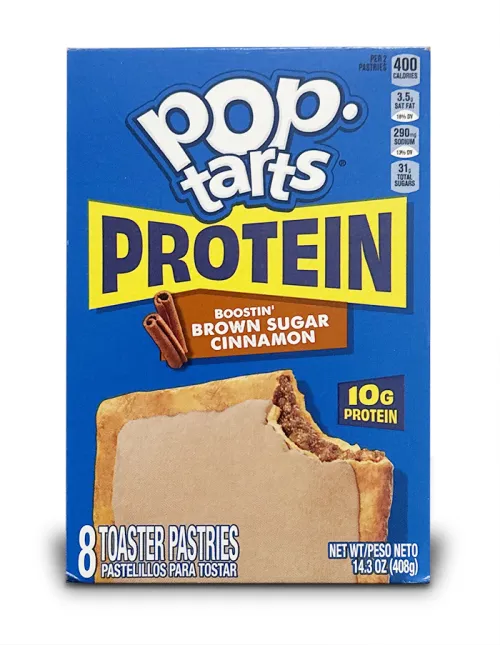
“PROTEIN,” shouts the huge yellow banner on Pop-Tarts Boostin’ Brown Sugar Cinnamon. Turns out the new protein varieties of classic Pop-Tarts only add enough wheat protein and milk protein concentrate to up the protein in a two-tart serving from 4 or 5 grams to 10 grams. But the serving will cost you 380 to 400 calories. That’s a pretty lousy deal.
“Protein” Pop-Tarts get most of their calories from white flour and added sugars, not protein. (A serving has 30 grams of added sugars—that’s roughly 120 calories from sugar alone.) They also deliver a dose of the preservative TBHQ and—in the blueberry and strawberry varieties—a smattering of synthetic dyes like Red 40, Blue 1, Blue 2, and Yellow 6. We rate all those additives as “avoid.”
2. Cheerios Protein Cereal
Marlena Koch – CSPI.
What’s so impressive about Cookies & Crème Cheerios Protein Cereal? Not a lot.On the upside, like all Cheerios, the oats are whole grain. But General Mills adds more sugar (11 grams per serving) than pea protein. And the protein (8 grams) isn’t much higher than original yellow-box Cheerios (5 grams). What’s more, getting an extra 3 grams of protein along with an extra 10 grams of added sugars—original Cheerios have just 1 gram—isn’t worth it.
3. Protein Pop
Marlena Koch – CSPI.
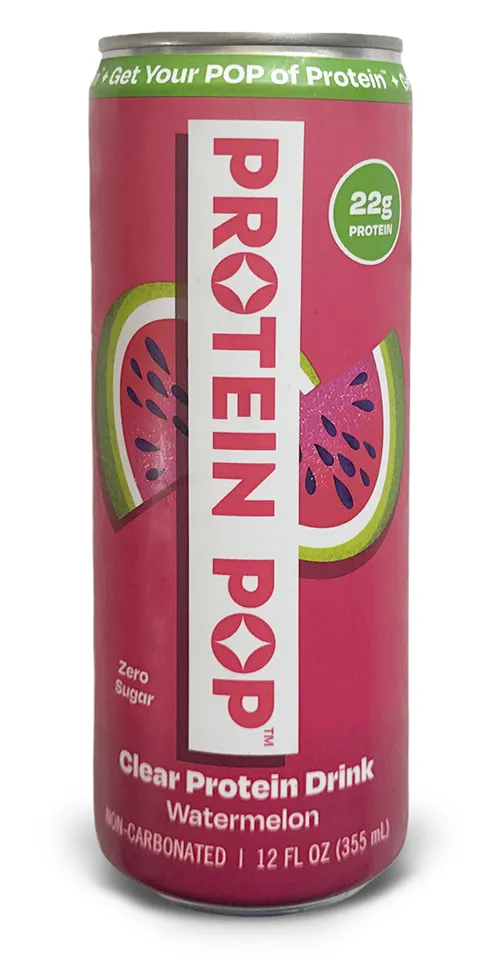
A can of Watermelon Protein Pop looks like soda, but it’s a non-carbonated “clear protein drink.” While Protein Pop has no added sugars because it’s sweetened with (safe) stevia extract, it does have 90 calories in a 12 oz. can. That’s two-thirds of the calories you’d get from a 12 oz. Coke.
Of course, Protein Pop’s calories all come from protein, not sugar. But here’s the thing: If you’re eating a healthy diet, you’re already getting more than enough protein from foods like dairy or soy milk, nuts and seeds, whole grains, and chicken, tofu, or beans. You don’t need to tack on 22 more grams…or the 90 calories that tag along. And those liquid calories are unlikely to fill you up and help prevent overeating the way chewing on beans, nuts, chicken, or other solid foods would.
4. Barebells Soft Protein Bar
Marlena Koch – CSPI.
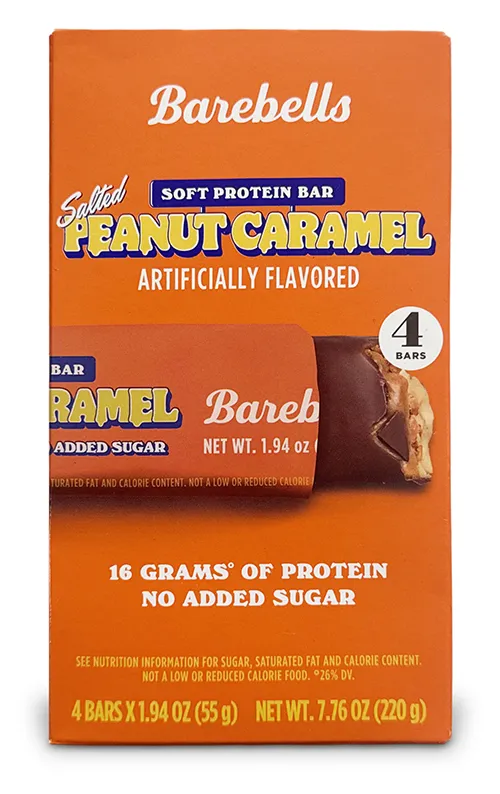
A 210-calorie Barebells Salted Peanut Caramel Soft Protein Bar is high in protein (16 grams) and free of added sugars, but it’s no chicken breast. The bar is high in saturated fat (blame its candy-like coating) and it’s partly sweetened with sucralose (a low-calorie sweetener that we rate as “avoid”). Then there’s the processed fiber polydextrose and the “sugar alcohols” maltitol and xylitol, all of which can lead to a laxative effect if you consume more than you can tolerate. (Individuals vary, but people with irritable bowel syndrome may be especially sensitive.)
The “salted peanut caramel” bar gets most of its protein from milk protein and collagen protein, not peanuts. In fact, you’d be better off snacking on 210 calories’ worth of peanuts (1-1/4 oz.). You’d still get some protein (9 grams instead of 16), but with healthier fats and no additives of concern, plus vitamins and minerals like folate and magnesium.
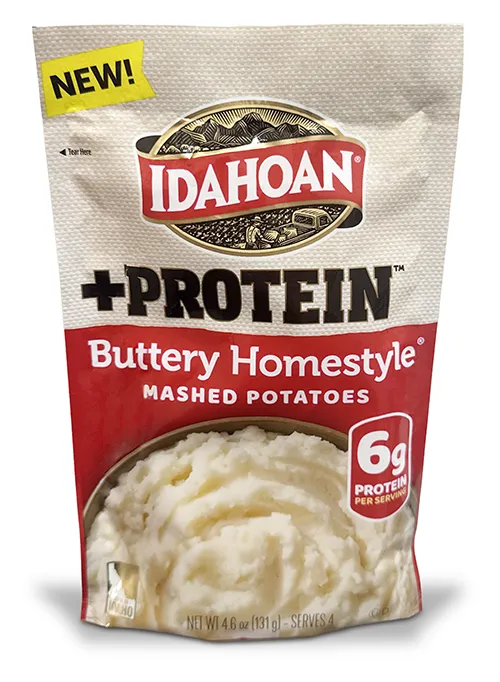
The powdered-protein marketing ploy has hit nearly every processed food. One of the latest: instant mashed potatoes.
A four-serving pouch of Idahoan +Protein Buttery Homestyle Mashed Potatoes costs about 30 percent more than a four-serving pouch of regular Idahoan Buttery Homestyle Mashed Potatoes. That’s a hefty premium for just 4 more grams of protein per serving (6 vs. 2). And you also get extra calories (130 vs. 110). What’s more, both the +Protein and the regular instant potatoes are high in sodium (460 milligrams per serving).
If you want more protein from your potatoes, mash your own, then stir in some plain Greek yogurt. (Or dollop a baked potato with yogurt instead of sour cream.) But most meals built around beans, tofu, poultry, meat, or seafood already have plenty of protein…so why even bother with adding protein to potatoes?
6. Quest Cheddar Blast Cheese Crackers
Marlena Koch – CSPI.
Quest Cheddar Blast Cheese Crackers are essentially Cheez-Its made with milk protein instead of white flour. And while the Quest crackers have more protein than Cheez-Its (10 grams in a 1 oz. serving, vs. 3 grams), neither wins. Compared to the Cheez-Its, the Quests have about twice as much sodium (420 milligrams) and saturated fat (3-1/2 grams). And Quest’s 5 grams of fiber largely come from processed polydextrose.
“Snack like a genius,” says Quest. But smart snackers in search of a savory crunch would be better off with a pouch of whole crispy chickpeas like those from Biena, Saffron Road, or similar brands. A 1 oz. serving of Saffron Road Organic Sea Salt Crispy Chickpeas, for example, has 6 grams of protein and 5 grams of fiber from chickpeas, with no sat fat, not too much sodium (210 mg), and no more calories than Quest. Love those legumes.
4 healthy protein-boosted foods
1. Ultra-filtered milk
NIQ Product Explorer.
Fairlife and other brands now offer “ultra-filtered milk” that filters out some of the naturally occurring lactose (a type of sugar) in dairy milk. The milk that remains is higher in protein and calcium, but no higher in calories. So a cup of Fairlife Fat Free Ultra-Filtered Milk ends up with 13 grams of protein and 30 percent of a day’s calcium, compared to a typical fat-free milk’s 8 grams of protein and 25 percent of a day’s calcium. Both have 80 calories. (Note: Fairlife is lactose-free because it adds lactase enzyme to digest any lactose that remains after ultra-filtration, but other brands may vary. If you’re lactose intolerant, always check labels.)
Looking for a plant-based milk pick? Any fortified soy or pea protein milk is a good start. For a few extra grams of protein, try new Original Silk Protein, which is made with soymilk and soy protein isolate.
2. Protein pancakes
Lindsay Moyer - CSPI.
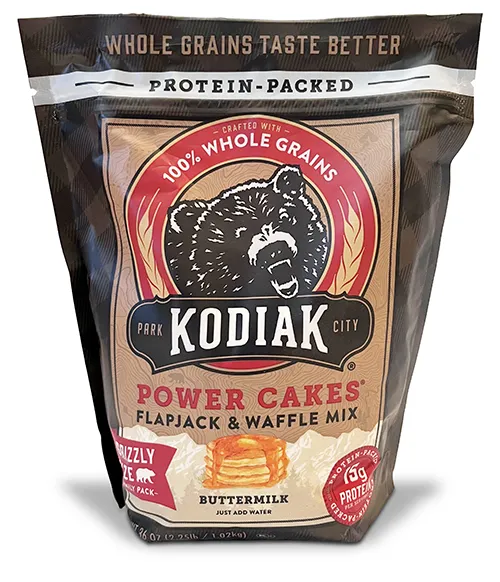
It’s not so easy to find a just-add-water pancake mix that’s made with 100 percent whole-grain flour. It’s even harder to find one that also adds some extra protein. But it’s worth the effort if it means you don’t have to think about rounding out your pancake breakfast with a serving of yogurt, eggs, milk, or another protein food (unless you want to).
Kodiak Power Cakes Buttermilk Flapjack & Waffle Mix has the whole package. Every 220-calorie serving—roughly three small pancakes—has an impressive 5 grams of fiber (from whole wheat flour and oat flour) and 15 grams of protein (largely from added wheat protein and milk proteins). The icing on the ’cakes: they have just 3 grams of added sugars…and they taste great.
3. Super firm tofu
Marlena Koch – CSPI.
Nasoya Super Firm Organic Tofu has more protein per bite than regular tofu because it has been pressed to remove more water. Each 3.2 oz. (130-calorie) serving delivers 14 grams of protein. That’s about 50 percent more than you’d get in the same amount of most other firm or extra-firm tofus.
Nasoya’s high-protein tofu is also a timesaver because it comes vacuum-packed. That means there’s little to no water to drain. So if you have a recipe that calls for squeezing the excess water out of ordinary tofu, you can just skip that step. Simply open the package, blot dry the block of tofu, cube or slice it, season, and sauté or bake.
4. Legume pasta
Marlena Koch – CSPI.
Pastas made of legumes—like red lentils, yellow lentils, chickpeas, or edamame—are superstars. Compared to whole wheat pasta, legume varieties have about as much (or more) fiber and two to three times as much protein. Bonus: If you need to eat gluten-free, most legume pastas fit the bill (always check the label).
Take Barilla Red Lentil Rotini. Its one ingredient (red lentil flour) pumps 14 grams of protein into a standard 2 oz. serving of pasta. (Don’t be fooled by the “25g PLANT PROTEIN” on the front of the box—that’s for a larger, 3.5 oz. serving.) Going with a higher-protein pasta like Barilla’s is a wise move if you’re putting together, say, a vegetarian pasta primavera with a variety of vegetables but no beans, tofu, tempeh, or plant-based meat.
That said, you’ll pay a premium for legume pasta. So if your meal already has a source of protein—and you can eat gluten—a box of whole wheat pasta will save you a few bucks.
Tip: If you can eat gluten and you prefer the taste of regular white pasta, try Brami Protein Pasta. Its first ingredient is semolina durum wheat—that’s just white (refined) pasta flour. But Brami adds enough of its second ingredient—lupini beans—to bump up the fiber (to 5 grams in 2 oz.) and boost the protein (to 12 grams). Nice!
CSPI heavily relies on our grassroots donors to fuel our mission. Every donation—no matter how small—helps CSPI continue improving food access, removing harmful additives, strengthening food safety, conducting and reviewing research, and reforming food labeling. We don't take donations from corporations, and our flagship publication, Nutrition Action, doesn't run any ads. That means that everything we do is fiercely independent and unbiased from any bad actors, no matter how powerful. To help keep this online content 100% free, consider donating today to support CSPI.
Our free Healthy Tips newsletter offers a peek at what Nutrition Action subscribers get—scrupulously researched advice about food of all kinds, staying healthy with diet and exercise, and more.