How do we know which food additives and chemicals are safe?
betka82 - stock.adobe.com.
There are thousands of chemicals in our foods and food packages. Getting a handle on them can feel like learning a new language. Without a solid foundation, it’s tough to know what matters. How are they tested for safety? Why are some banned in Europe but not the US? CSPI’s very own toxicologist walks us through it.
Thomas Galligan - CSPI.
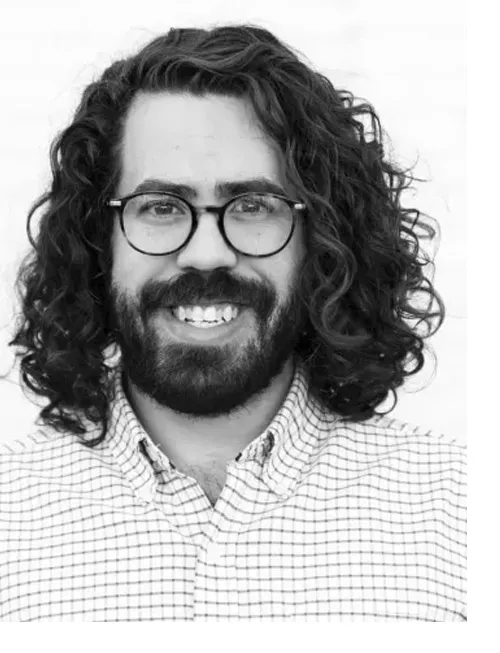
THOMAS GALLIGAN is Principal Scientist for Food Additives and Supplements at CSPI. Galligan works to improve the regulation of food chemicals and keep unsafe ones out of the food supply. He spoke with Nutrition Action’s Caitlin Dow.
Hazard versus risk
What’s the difference between a hazard and a risk?
TG: The two terms are often conflated, but they’re distinct. Hazard is the inherent ability of something to cause harm, whereas risk is the likelihood that it will actually harm you.
Imagine a chef’s knife with its sharp blade. That has the ability to hurt you. It’s a hazard. But if you put the knife in a locked drawer, it poses no risk.
If you take that chef’s knife out of the drawer and start cutting vegetables with it, the risk goes up. Now put it in your non-dominant hand, turn the lights off, and start cutting vegetables. You are almost guaranteed to be hurt by it.
So a hazard only poses a risk if there’s some degree of exposure.
Is exposure the only thing that matters?
TG: No. In the case of the knife, its properties also matter. If the chef’s knife were a butter knife, even in your non-dominant hand during an earthquake in the dark, it’s probably not going to hurt you.
The same idea applies to chemicals. At CSPI, we focus more on the chef’s knives than the butter knives of the food-chemical world. We want policymakers to enact regulations that ensure that those chef’s knives don’t hurt us.
Confused by hazard and risk? A hazard—like a chef’s knife—only poses a risk if you’re exposed to it.
motortion - stock.adobe.com.
Assessing Hazard & risk
How do scientists determine if a chemical is dangerous?
TG: Risk assessment is a multi-step process. The first step is to identify and characterize the hazard, which means understanding how much a chemical can harm us.
To do that, the FDA and other regulators rely heavily on animal studies. But they bolster those findings with studies in cells and, more recently, with computer modeling and AI tools.
The next step is to determine exposure, then bring that together with hazard in order to understand risk.
What about studies in people?
TG: Human trials are rarely used to understand chemical safety.
For chemicals that are already in the food supply or the environment, scientists use observational studies to see whether exposures to hazardous chemicals are associated with risk in the real world.
But that data often isn’t available, and isolating the effect of a chemical exposure is tricky.
What are the advantages of studies conducted in cells?
TG: They are very quick, low-cost, and efficient compared to animal or human testing. And if you’re using human cells, the results can be directly relevant to humans.
Are there drawbacks?
TG: Humans aren’t just cells in a test tube in a lab. We’re complex organisms that are made of tissues and organs that interact with one another and with the real world. A cell experiment can’t fully replicate that.
Why do researchers test chemicals in animals?
TG: The most direct way to determine the risk of a chemical to people is to study people, but that’s impractical and could be unethical.
The average lifespan of humans is in the mid-70s. So doing a lifetime exposure study is out of the question.
And if you think a chemical might cause harm to people, research institutions rightly won’t let you expose them to it.
At the moment, animal studies are the next best thing.
Why?
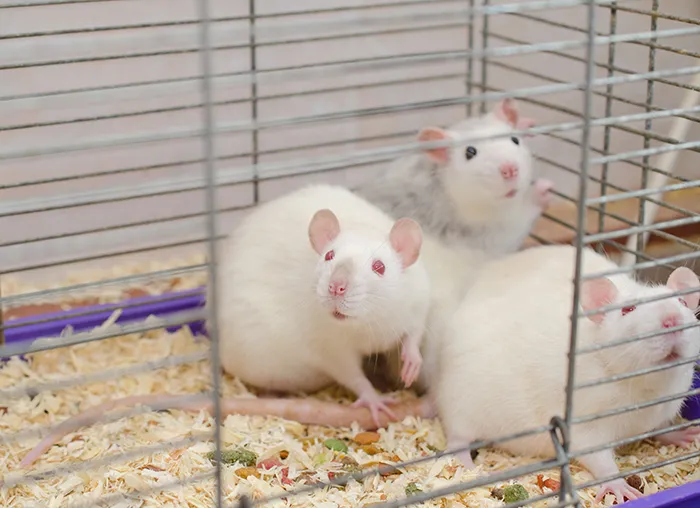
TG: Most studies use rats or mice, mammals with organs and physiological processes similar to humans.
For example, the liver may break down a chemical and detoxify it, the GI system excretes it, and tissues that are damaged can sometimes repair themselves. Testing in animals allows all of those processes—which are often similar in humans—to play out so we can see what effects emerge across the entire body.
So if you add a chemical to a rat’s food, it’s a decent analog for humans who eat that chemical in their food.
But lab rats aren’t an exact mirror of humans, right?
TG: That’s right. Humans live in a much more complex world. We eat different things, have different jobs. You live in DC. I live in Oregon. Our exposures are different. And all of that is happening against a backdrop of genetic diversity with more than 8 billion of us on the planet.
Animal studies are typically run with a few hundred genetically identical animals that are living in a highly controlled environment, eating the same diet.
Can we really apply the results in animals to humans?
TG: We use animals as a red flag to identify possible harm in humans. To ensure that we’re being protective, the baseline assumption is that if it causes harm in an animal, it will also cause harm in people unless clearly demonstrated otherwise.
Of course, rodents aren’t little people and humans aren’t big rats. There are differences between species that can influence how we respond to exposure to a chemical.
Sometimes humans are more sensitive than rats and mice, other times we’re less sensitive or not sensitive at all.
Studies in lab animals can help identify risky food chemicals, but the animals’ controlled world doesn’t mirror the complexity of ours.
Kurashova - stock.adobe.com.
Why do studies often give animals huge doses of a chemical?
TG: High doses are used to reveal hazards and characterize or understand them. A well-run animal study will use a wide range of doses, including high doses as well as doses that mimic the expected human exposure level.
High doses help ensure that we’ll get a sense for which organs are affected. They help detect rare effects that might only show up in one out of a million animals at lower doses. And they compensate for the shorter lifespan compared to humans.
By using a broad range of doses, you can understand what’s called the “dose response.” If you expose the animal to more of the chemical, does the response go up? That’s important in understanding the risk to humans.
Regulators use that data to estimate a safe dose in humans. They typically divide the safe dose in animals by 10 to account for the possibility that people might be 10 times more sensitive to the chemical than animals. Then they usually divide it by 10 again to account for the fact that some people might be more sensitive than others.
Bottom line, animal studies are relevant, but that doesn’t mean they’re perfect.
Do animal studies ever miss an effect?
TG: Yes. Synthetic food dyes are a good example. We know from human studies that these dyes can cause or worsen behavioral problems in some children. But the animal studies that the FDA relied on to approve the dyes didn’t evaluate behavior.
On top of that, the FDA often reviews studies that are performed by the company that’s seeking approval for a chemical, so there’s an inherent conflict of interest.
That’s why it’s important to design studies to be broad, both in terms of doses and outcomes, and for the FDA to consider studies—when they exist—that haven’t been designed by the chemical maker.
Is the field moving away from animal studies?
TG: Yes. There’s been a growing push to do that, given the limitations of animal-based toxicology as well as the broader interest in reducing the use of animals in research for ethical reasons.
What’s the alternative?
TG: They’re called new approach methodologies, or NAMs. They combine cell-based studies and computer methods for assessing toxicology.
The idea is to go beyond the basic cell methods and do things like build an organ on what are called organ-on-a-chip devices. You have all the trappings of a liver on a single chip, so you can test how the whole liver might respond to a toxic chemical.
The goal is to make NAMs sophisticated enough to erase the need for animal studies.
Is that possible?
TG: It’s the goal of the chemical industry as well as a number of regulatory agencies. The EPA, for example, has said that it wants to move beyond mammals in research by 2035.
While we’re moving toward that goal, there’s a long way to go before we get there. Right now, NAMs are nowhere near being able to replicate the cross-talk, if you will, between the organ systems of a whole body. If the transition to NAMs happens too quickly, we’ll know less about the potential harms of a chemical. That may be why the chemical industry is so interested in NAMs.
The dose makes the poison?
What does the phrase “the dose makes the poison” mean?
TG: This is one of the core principles of toxicology. It’s the idea that anything is toxic if you’re exposed to a high enough dose. Or, looking at it the other way, a safe dose can theoretically be found for any chemical.
It depends on the quality of evidence that you have for both hazard and exposure.
Have we accounted for the fact that some people may be more susceptible to a chemical than others? Are people exposed to other chemicals at the same time that could affect their response to the chemical in question?
Those questions and many others need to be answered, and that requires technical expertise and some degree of subjective decision-making.
So I think that when the average person hears “the dose makes the poison,” they don’t understand that nuance and complexity. They may believe that determining a safe dose is a straightforward, simple process.
Are there cases when the dose doesn’t make the poison?
TG: Yes. There are types of chemicals that can theoretically cause harm at any dose.
For example, any amount of a genotoxic carcinogen—genotoxic means that it damages DNA—can cause cancer. Even a single molecule of a genotoxic carcinogen can interact with a single strand of DNA, cause a mutation, and theoretically give rise to cancer.
But even for those chemicals, it’s generally true that as exposure increases, cancer risk also probably increases. But there’s no amount that isn’t a poison.
Does the harm always increase as the dose increases?
TG: Not always. For example, in animal studies of the plastic additive bisphenol A, or BPA, researchers have seen that low doses increased the risk of some negative outcomes like tumor growth that weren’t seen at higher doses.
Finding a safe dose is difficult when you’re dealing with chemicals that don’t respond in a nice linear way.
And individuals vary?
TG: Right. A safety threshold will not be universal across the entire human population. So the dose that’s safe for you may not be the dose that’s safe for me. A person can be genetically, environmentally, or developmentally predisposed to be more susceptible, or less susceptible, to a toxic chemical.
Many factors—like life stage—affect susceptibility to toxic chemicals. Young children are typically more vulnerable than adults.
M-image - stock.adobe.com.
Life stage also matters. Babies developing in the womb, infants, and young children are generally more susceptible to toxic chemicals than adults. Early-life exposure could cause an immediate effect that lasts forever—like the fact that lead can cause permanent brain damage in children. Or exposure could result in a disease later in life, like heart disease or cancer.
And the reality is that some pack-a-day smokers do—and others don’t—get lung cancer. It’s not just the dose that determines the outcome.
Banning risky chemicals
Many food chemicals are banned in Europe but not in the US. Is that a useful comparison?
TG: It can be helpful to look at what other authorities have said about whether a chemical is safe or how we should assess safety.
The EU is an interesting counterpoint to the US. One reason is that the European Food Safety Authority is required to consider what’s called the precautionary principle. If EFSA has reason to believe that a chemical could pose a significant risk but there’s uncertainty or a lack of data to assess that risk, it errs toward caution. It doesn’t allow the chemical in food.
The US doesn’t explicitly follow the precautionary principle, but we have a rule that requires that no substance, in any amount, can be intentionally added to food if it has been shown to cause cancer in people or animals.
CSPI recommends avoiding titanium dioxide—which is still used in foods sold in the US—for the same reason.
What’s the FDA’s approach?
TG: The FDA basically treats every chemical as safe until it’s proven to be harmful. I think that’s backward. And I think a lot of researchers and the public agree. That’s probably why we’re seeing so many calls for change from consumers.
What’s the right approach? Let’s thoroughly test a chemical. Let’s fully convince ourselves that it’s safe before anyone eats it.
Should the FDA follow EFSA?
TG: No. It’s not infallible. For example, both the FDA and EFSA still consider the sweetener aspartame to be safe, even though there are—at a minimum—valid questions about its safety and the World Health Organization considers it “possibly carcinogenic.” CSPI has urged the FDA to ban aspartame.
I’d argue that EFSA didn’t sufficiently employ the precautionary approach in the case of aspartame.
And, for some reason, the artificial sweetener cyclamate is still legal in the EU, even though the FDA banned it in 1970 after animal studies suggested that it causes cancer.
Managing toxic chemicals in your life
How can people figure out what’s safe?
TG: They shouldn’t have to. A strong federal government should be ensuring that food additives are safe so people don’t have to think about them.
Unfortunately, consumers are currently bearing that unfair burden.
How should they manage it?
TG: First, recognize that chemical safety isn’t binary. It’s not “safe” or “avoid it all the time, and if you don’t, you’re going to get cancer.”
I want people to find practices that fit their lifestyle that are realistic and sustainable.
It’s impossible to fully eliminate your exposure to many chemicals. But taking small steps that feel within reach is still a good idea.
Don’t microwave your food in plastic. Consume less processed meat and alcohol. To reduce your exposure to mercury, swap your albacore tuna for light tuna or, even better, salmon.
These types of things are achievable for many of us and don’t require a PhD in toxicology or even that you review ingredient lists.
Where can people get reliable information?
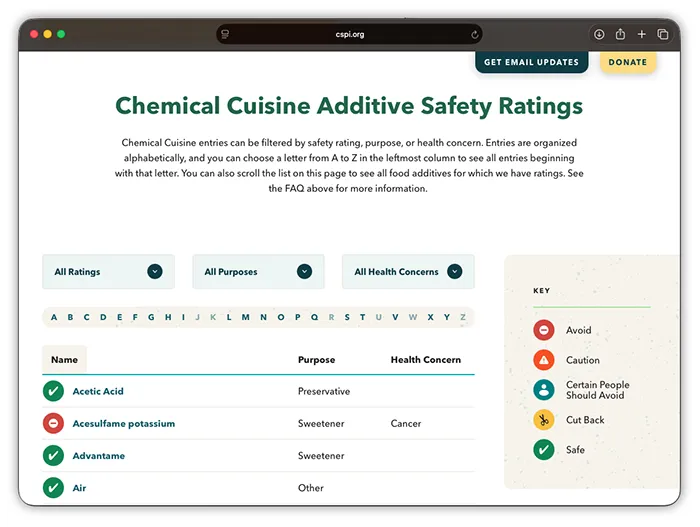
TG: If they’re reading this, they’re already part way there. In addition to publishing Nutrition Action, CSPI has a database called Chemical Cuisine, which houses our food additive safety ratings.
But I’d also encourage people to stay in touch with CSPI, go to cspi.org/actionalerts to sign up for our emails, and write to their lawmakers when we identify instances where that could make a difference.
In the end, fixing the government’s broken oversight system is what will solve the problem for everybody.
CSPI heavily relies on our grassroots donors to fuel our mission. Every donation—no matter how small—helps CSPI continue improving food access, removing harmful additives, strengthening food safety, conducting and reviewing research, and reforming food labeling. We don't take donations from corporations, and our flagship publication, Nutrition Action, doesn't run any ads. That means that everything we do is fiercely independent and unbiased from any bad actors, no matter how powerful. To help keep this online content 100% free, consider donating today to support CSPI.