Are you thinking of splurging on a “hormone balance” supplement? Or maybe you’re considering “cycle syncing”—syncing your diet and exercise routine with your monthly cycle. If so, hormone balance probably isn’t what you think it is. Here’s where claims about women’s hormones from the online wellness crowd miss the mark…and what really matters.
Can you really have a hormonal imbalance?
Your body makes more than 60 hormones day in, day out. “These chemical messengers are released from one part of the body to tell another part what to do,” explains Rashmi Mullur, an endocrinologist and clinical professor of medicine at UCLA.
Normally, “hormones are tightly regulated by the body’s signaling systems,” she adds.
But they can go haywire when you have health issues like type 1 diabetes, where the body can’t make the hormone insulin, or PMOS (formerly called PCOS), where women have insulin resistance and high levels of the hormone testosterone.
In cases like those, the body produces too much or too little of a hormone or can’t respond properly to normal hormone levels. That’s called a disorder, and it’s very different from an imbalance.
A disorder typically has a known cause and can be diagnosed with testing, notes Mullur. It has predictable consequences and requires treatment. An imbalance has no clear definition, which leaves the term ripe for wellness-industry exploitation. In fact, modern medicine doesn’t even formally recognize the term.
Why not?
Hormones fluctuate in predictable patterns over minutes, hours, days, or weeks. But they also respond to what’s going on around you—like a tense situation that pumps up your stress hormones. “Your hormones are constantly fluctuating based on your body’s needs,” says Mullur. “Those fluctuations keep your body functioning the way it needs to and are not considered imbalances.”
In other words, the term “imbalance” doesn’t capture how hormones act. It’s just a marketing buzzword pretending to be a medical fact…and it’s not what’s to blame for common health complaints like fatigue, mood swings, or acne.
But our normal hormonal ebbs and flows can be the source of symptoms that affect how we feel. For many people—especially women—that’s exactly what happens.
Malambo - stock.adobe.com.
Do women need to ‘balance’ their estrogen and progesterone levels?
Period cramps, hot flashes during menopause, nausea during pregnancy…these are just some of the symptoms that can accompany shifting hormones.
Consider the hormones that coordinate the menstrual cycle: estrogen and progesterone. It’s no wonder that so much content on social media zeroes in on those two, or that many women see their doctors for worries about an imbalance.
“People often associate ‘hormonal balance’ with women’s health issues related to the menstrual cycle or hormone replacement therapy,” says Mullur. For example, some forms of HRT for symptoms of menopause can cause breast pain, a possible sign of too much estrogen exposure. In that case, she says, it may make sense to dial back a patient’s dose.
But in a premenopausal woman, recurring breast pain a week before a menstrual period isn’t tied to a specific hormone level. And the common belief that the pain is a sign of an estrogen-progesterone imbalance isn’t true, either. (The two hormones naturally flip-flop throughout a typical cycle.)
What causes mood swings, fatigue, weight gain, and other signs of ‘hormone imbalance’?
We still don’t know why breast pain, mood changes, fatigue, or other cycle-related symptoms affect some women and not others. They may just be more sensitive to the roller coaster of normal hormone fluctuations—not specific hormone levels or hormone “imbalances.”
“Even when their hormones are in the normal range, some women still have difficult-to-manage periods,” says Mullur. “Their symptoms are not caused by a hormonal disorder or by a so-called imbalance.”
For women who are suffering, that can be tough to hear, acknowledges Mullur, who adds that when patients don’t meet the criteria for a diagnosable condition, modern medicine can often only treat symptoms without dealing with their root cause.
Is ‘cycle syncing’ the solution to hormonal symptoms?
It’s frustrating when doctors can’t fix our health woes. On top of that, “gaslighting and disenfranchisement in medical settings may make women lose trust in the medical system,” says Emily Pfender, an assistant professor of communication at the University of Delaware who specializes in women’s health. (Pfender has received sponsorships from Wisp Women’s Health, a women’s telehealth platform, for social media posts.)
That breakdown in trust could be fueling a trend called “cycle syncing,” says Pfender.
Cycle syncing? It’s a set of dietary and lifestyle rules (sometimes including a costly supplement regimen) that purportedly correct a woman’s hormonal imbalances and curb her period and acne problems.
To cycle sync, women must modify “what they eat, how they exercise, and how they work” based on which phase of the menstrual cycle they’re in, Pfender explains. “And some cycle-syncing content pushes the idea that you’ve got to get off hormonal birth control” to balance your hormones. (Systemic forms of birth control, like pills and injections, work in part by suppressing cyclical hormonal changes—a big no-no for cycle syncers.)
Thitiporn - stock.adobe.com.
The belief is that fluctuating menstrual hormones are so sensitive to the slightest insult (say, eating too much sugar) that women must align their lifestyles with “female biological processes” to maintain optimal hormonal balance, says Pfender. (Lifestyle matters, but our bodies aren’t that fragile.)
How exactly does one sync their cycle?
To find out, Pfender and her team created a profile for a fictitious 22-year-old on TikTok, then analyzed the top 100 videos that appeared after the fake user searched for “cycle syncing.” The videos’ advice wasn’t consistent, but a recurring theme was that women should rest, walk, or stretch during their periods, then switch up their exercises (like cardio or weightlifting) at other points in their cycles. The videos also named iron- and magnesium-rich foods, along with warm foods, as good to eat during periods.
We found other cycle-syncing posts on Instagram that recommended foods like broccoli and carrots, herbs like dandelion root and nettle leaf, and supplements like vitamin C and quercetin for different phases of the cycle. Some of those were touted for their “estrogen-balancing” or “progesterone-supporting” qualities while others had no explanation. In any case, none of the posts we found cited evidence to back up their claims.
Does cycle syncing work for PMOS (PCOS) and ‘hormonal imbalance’ symptoms?
While researchers have looked at exercise performance across the menstrual cycle, no peer-reviewed studies have tested a diet-and-exercise-based cycle-syncing approach for its impact on women’s health, says Pfender. But that hasn’t stopped the wellness industry from marketing “hormone-supporting” regimens to women.
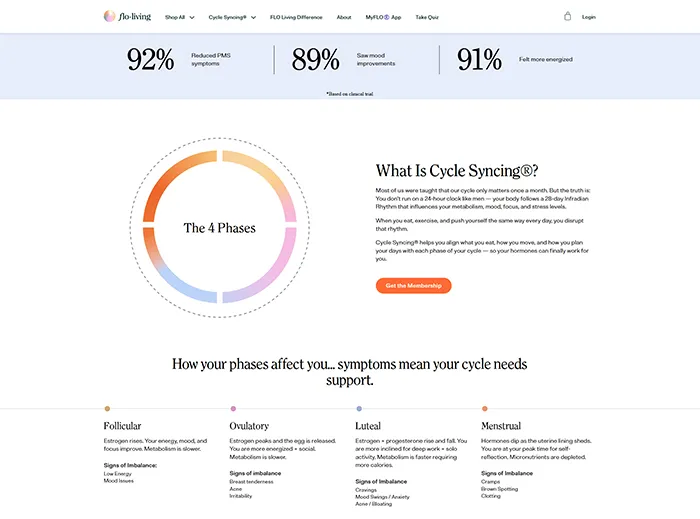
Case in point: FLO Living, a company that sells a “food therapy course,” telehealth coaching, and supplements for “preconception,” PMOS, perimenopause, and period issues. “Your cycle is a fifth vital sign—as important as temperature or blood pressure,” says FLO Living’s website. “When symptoms appear, they’re your body’s monthly ‘hormone scorecard.’ The Cycle Syncing Method shows you exactly how to read (and improve) that score.”
floliving.com
FLO Living boasts that its Cycle Syncing Method—an app-based nutrition and lifestyle program—is backed by a clinical trial. But the trial, which was conducted by a for-profit contract research company that works with many wellness brands, was never published in a peer-reviewed scientific journal. Instead, the results appear in a white paper (a summary of the research) that’s available through FLO Living’s website.
In the trial, 60 premenopausal women followed FLO Living’s Cycle Syncing Method for three months while wearing blood sugar monitors and logging daily symptoms. They also filled out questionnaires about changes in their symptoms each month. After three months, 86% of the women reported fewer PMS symptoms, and 94% reported “feeling” like their blood sugar was more stable—though the monitors showed that their blood sugar hadn’t changed over time.
Throughout the trial, the women also received “weekly coaching” with the company’s founder. (In an email, FLO Living’s customer service department told us that the coaching sessions were opportunities for the participants to ask “general questions,” but they didn’t provide examples of the questions or answers.)
Between the weekly contact with the research team via coaching and the lack of a control group—the trial didn’t compare the participants to women who weren’t following the Cycle Syncing Method—it’s impossible to know what the findings mean.
What’s the price tag of that regimen? While the exact same program isn’t available to you or me, access to the Cycle Syncing Method and monthly group coaching with the founder will cost you $28 a month, a customer service representative told us. (Note: The trial included weekly coaching.) Want to tack on “Balance Supplements,” “Cycle Syncing Supplements,” and twice-monthly group coaching with the founder? That ups the monthly bill to $139. And if you want a more personalized experience, one-on-one coaching will run you $175 an hour.
Even though no good research has tested cycle syncing, might some of its aspects have merit, like the idea that women should modify their exercise habits depending on which phase of the cycle they’re in?
Research hasn’t tested whether that can affect a woman’s hormonal health, as cycle syncers claim. On the flip side, dozens of studies have tested whether cyclical hormone changes might affect athletic performance. That research, which measures outcomes like strength, endurance, and speed at different points in the menstrual cycle, has mixed findings.
In one analysis of 78 studies, the evidence didn’t support the idea that menstrual cycle phase affects performance—except maybe while having a period. But most of those studies had fewer than 15 volunteers, and some suffered from design flaws like not testing participants’ hormone levels to determine which phase they were in.
In one higher-quality trial that did use hormone testing, 13 women in their 20s rode a stationary bike for a set distance as fast as they could at three points in their menstrual cycle: during or just after their period (when the uterus sheds its lining), near ovulation (when a mature egg is released from the ovary), and during the luteal phase (when the uterine lining thickens). The only difference: the women rode about 5% faster just before ovulation than during or just after their periods. (That may matter for a competitive cyclist, but it’s unlikely to even register for an everyday exerciser.)
That makes sense, since “some women report feeling weaker and less motivated to exercise during menstruation,” says Pfender. Even so, another high-quality study found no performance differences by phase. It will take better evidence from larger trials to know whether phase truly makes a difference. In the end, it may come down to individual experience.
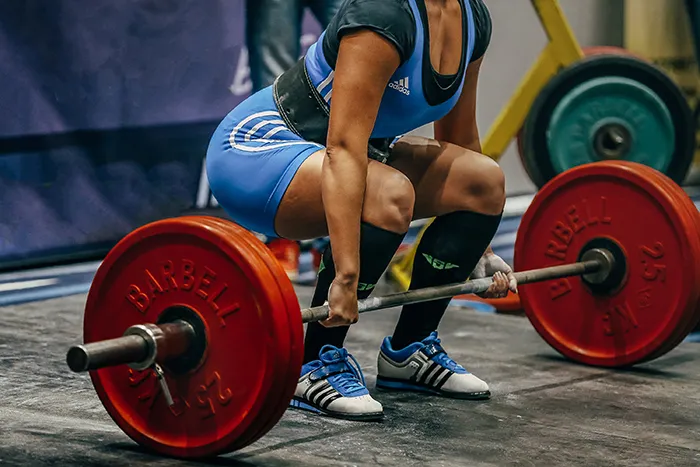
Of course, none of this means that you should avoid vigorous exercise and only do, say, yoga while on your period. If you need to rest or exercise at a lower intensity on days when your symptoms are worse, do what’s best for you. Just don’t assume that scaling back is a must while menstruating…or that intense exercise during that time will wreck your hormones.
Real Sports Photos - stock.adobe.com.
And speaking of hormones, what about the claim that cycle syncing can “balance” them? We couldn’t find any published studies that have tested it. Pfender’s take: “A lot of conversation online makes women believe that their hormones are not balanced, but I don't know what ‘hormonal imbalance’ means, and I don’t think people who use that term know what it means, either.”
Is cycle syncing safe?
Cycle syncing might seem harmless—or even empowering—but it has risks:
Trying to “fix” bothersome symptoms on your own could delay the diagnosis or treatment of conditions like endometriosis, PMOS, or uterine fibroids.
Loading up on supplements could lead to serious problems like allergic reactions, interactions with medications, or exposure to contaminants.
For women who don’t need to slow down while on their periods, avoiding exercise for one week out of every month does their long-term health no favors.
Rejecting hormonal birth control could lead to unwanted pregnancies since it’s more effective at preventing one than, say, using condoms based on when you think you’re ovulating. While hormonal birth control comes with its own low risks of serious outcomes like blood clots, it’s necessary for some who have painful periods, and forgoing that treatment would cause them needless suffering.
What can you do to support your hormonal health?
No supplement or lifestyle hack can “balance” your hormones or treat a hormonal disorder, notes Mullur. But taking care of yourself—both your body and your mind—can help keep your hormones functioning normally.
“If you feel that your hormones are not ‘in balance,’ the first step is to identify what symptoms are bothersome and what makes you feel well,” says Mullur.
For you, that may mean getting enough sleep—at least seven hours a night for most adults. “Good sleep is what sets us up to have the most normal response to our hormonal demands,” says Mullur, who adds that eating on a consistent schedule, getting enough fruits and vegetables, exercising regularly, staying hydrated, and managing stress are also important factors.
Her advice: “Shift your thinking from ‘balanced hormones’ to ‘balanced living.’”
CSPI heavily relies on our grassroots donors to fuel our mission. Every donation—no matter how small—helps CSPI continue improving food access, removing harmful additives, strengthening food safety, conducting and reviewing research, and reforming food labeling. We don't take donations from corporations, and our flagship publication, Nutrition Action, doesn't run any ads. That means that everything we do is fiercely independent and unbiased from any bad actors, no matter how powerful. To help keep this online content 100% free, consider donating today to support CSPI.