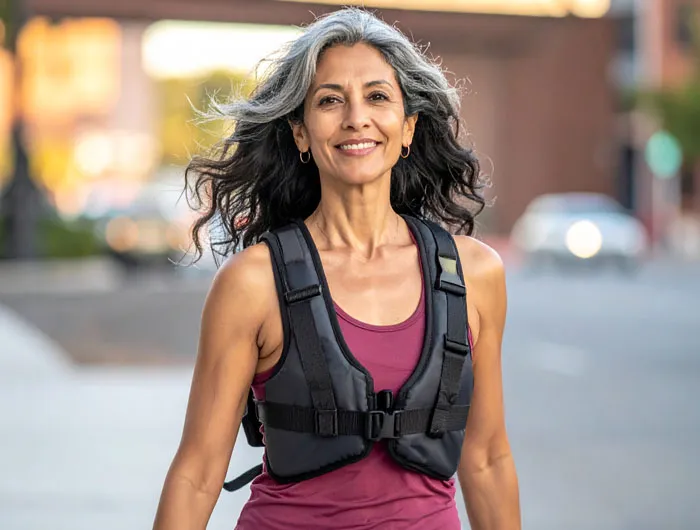
“Every woman over 40 needs to buy a weighted vest,” says one fitness influencer on Instagram. Why? Vest enthusiasts tout benefits for your bones, muscles, waistline, and more. “2025 is the year of the vest,” says Kristen Beavers, professor of medicine at Wake Forest University, with a laugh. “The way these vests are marketed, you’d think they can do anything. But that’s not true.”
What can a weighted vest do?
Does a weighted vest improve strength?
Why might a weighted vest do a body good? The idea is that by adding more weight to your body, your heart, lungs, and muscles have to work harder. No time to get to the gym? A weighted vest can supercharge the activities you’re already doing, say proponents.
And while vests do show benefits in some studies, the evidence is slim. “For older people who wore them compared to those who didn’t, there were improvements in strength or function,” says Beavers. “They could get out of a chair faster; their balance was better.”
In one small pilot trial, 19 older adults were instructed to do a home-based exercise program three times a week that included lower-body strength training exercises plus walking for 30 minutes. Roughly half of the volunteers were randomly assigned to wear a vest that weighed 10 percent of their body weight while they were exercising. After 12 weeks, measures of strength and function improved in both groups. But the vest wearers gained more strength, were able to walk farther in a six-minute test, and were able to get out of a chair more quickly than those who exercised without a vest.
Can a weighted vest improve bone health?
A common reason that influencers and fitness forums cite for using a weighted vest is to build (or not lose) bone. But the evidence to support that claim is far from a slam dunk. For starters, few studies have looked. And some compared people who were randomly assigned to strap on extra weight while they exercised to people who weren’t assigned to exercise, rather than to people who exercised without a vest.
That was the flaw in one of the most frequently cited studies. In it, 18 postmenopausal women who had completed a nine-month exercise program volunteered for a longer trial. Half were randomly assigned to perform lower-body strength training and jumping exercises while wearing a weighted vest three times a week for an average of 32 weeks each year for five years. The other half was told to maintain their usual activity (which may or may not have included exercise).
After the five years, the weighted exercisers had more bone mass in their hips compared to the usual-activity group. And they didn’t just preserve their bone mass, they built more bone. While those results are interesting, they can’t say if it was the lower-body strength training, the jumping, the weighted vest, or the combination that improved bone mass. What’s more, the trial wasn’t randomized. The women selected which group they wanted to be in, so something else about the exercisers might explain the results.
In a better-designed (but far shorter) study—it compared weighted exercisers to non-weighted exercisers—36 postmenopausal women with osteoporosis were randomly assigned to a control group that did no extra exercise or to a group that walked on a treadmill for 30 minutes three times a week, either with or without a weighted vest. After six weeks, blood markers of bone health improved in both exercise groups, with no differences between groups. (The study was too short to look at bone mass, the more important outcome.) However, the weighted walkers lost four more pounds of fat, gained more muscle, and improved their balance more than those who walked without a weighted vest.
Can a weighted vest help curb bone loss during weight loss?
“We know that when people lose weight, they don’t just lose fat,” says Beavers. “They also lose muscle and bone. And for older adults, that has been shown to increase the risk of fracture.”
Why do we lose bone when we lose weight? “Your skeleton responds to the load that it’s placed under,” Beavers explains. Translation: More weight equals more bone. “So if one reason that people lose bone with weight loss is because they literally don’t weigh as much, could we load them back and make their skeleton think that they are weight stable?”
To find out, Beavers randomly assigned 133 older adults with excess weight to one of three groups: cutting calories only, cutting calories plus strength training three times a week, or cutting calories plus wearing a weighted vest for eight hours a day. For the third group, “We replaced the weight that they lost via the vest,” says Beavers. “So people would come in throughout the study, we’d weigh them and, based on how much weight they had lost or regained, we put weight in or took it out of the vest.”
After a year, all groups had lost roughly 10 percent of their starting weight. All also lost between 1.2 and 1.9 percent of the bone in their hips, with no differences between groups. “The weighted vest was not able to stop the loss, and neither was strength training,” says Beavers.
What kind of exercise builds bone?
If not a weighted vest or resistance training, what would it take to build (or not lose) bone as we age? “You probably need more impact,” says Beavers. (That means activities like running, dancing, playing tennis, or climbing stairs versus non-weight-bearing activities like cycling or swimming.)
In one trial, researchers randomly assigned 86 postmenopausal women with osteopenia (lower-than-normal bone mass) or osteoporosis (low bone mass) to complete 30 minutes of either a low-intensity exercise program using no weights or light weights or supervised, high-intensity resistance and impact exercises (like dropping to the floor after jumping into a chin-up) twice a week. After eight months, only the high-impact exercise prevented a loss of spine and hip bone. (The supervision piece of this study was important. If you have osteoporosis and want to try high-intensity exercise, use a personal trainer and talk to your doctor first.)
How to use a weighted vest
Want to give a weighted vest a whirl despite the mixed reviews? If you aren’t already doing strength-training exercise, your best bet is to start low and go slow. Buy a vest that you can add weight to and start with about 5 percent of your weight, building to 10 percent or so.
Who shouldn’t wear a weighted vest? “If you have back or joint pain, a vest might exacerbate it,” Beavers points out. Got osteoporosis? Talk to your doctor before investing in a weighted vest.
And keep in mind that some activities aren’t weighted-vest friendly. “We don’t want you to do a lot of bending or twisting while wearing a vest,” says Beavers. Gardening or doing yoga? “Please take the vest off.”
If you try a weighted vest, “in order to see a benefit, you need to progress,” says Beavers. “If you’re wearing the same weight every day, the progressive stimulus is not there. So you need to start walking at a faster pace or put more weight in the vest in order to see a strength benefit.”
Bottom line
Don’t expect a daily walk with a weighted vest to curb bone loss. But assuming you don’t have back, neck, or joint pain and aren’t at risk for a fracture, there’s little harm in wearing one. You’ll make your workouts more challenging and may get a small boost in your strength, balance, and cardiovascular fitness.
“Getting people to exercise is really challenging,” Beavers acknowledges. “There’s probably a whole group of people who weren’t even walking, and if a vest gets them outside and moving, great.” That doesn’t mean it’s a replacement for strength training. “But it’s something.”