On the hunt for a new pair of running shoes? Should you go minimalist and feel the earth beneath your feet? Or maximalist and envelop your trotters in a cloud-like layer of foam? If you’re a walker, not a runner, does the answer differ? Can you rely on a salesperson to point you in the right direction? We’ve got the answers you need.
What makes a shoe minimalist or maximalist?
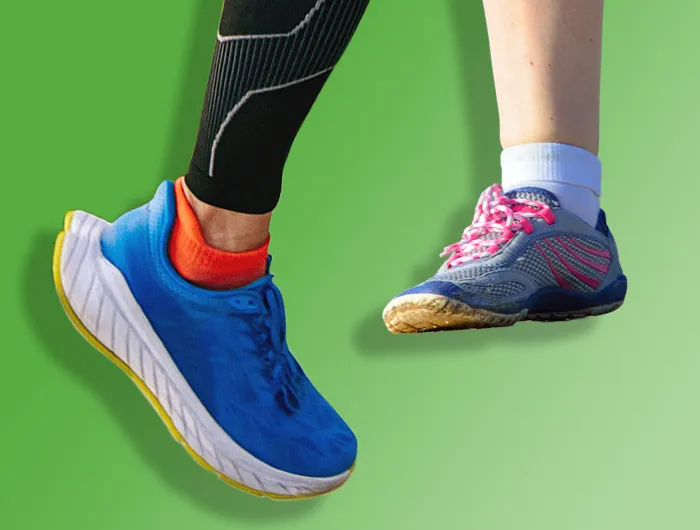
There are five features of minimalist shoes, says Jean-François Esculier, head of research and development at The Running Clinic and clinical associate professor in the department of physical therapy at the University of British Columbia. “They’re thinner, they have a lower drop, which means the heel is not as elevated versus the front of the shoe, they’re more flexible, they’re lighter, and there are fewer technologies to control the movement of the foot and to give stability.”
What about a maximalist shoe? “The key feature is that it’s thicker, so there’s more foam under the foot,” says Esculier. “Most of the time, those shoes will also have a higher drop or slope. And maximalist shoes are usually stiffer, so they won’t really allow your foot to adjust its position based on the terrain.”
To understand where a shoe falls on the minimal/maximal scale, Esculier and his colleagues created the “minimalist index,” which rates shoes on a scale of 0 to 100 percent. “A score of 100 percent would be a minimalist shoe like the Vibram FiveFingers,” says Esculier. “If you go toward the other end of the scale, you’ll find thicker, stiffer, more supportive shoes.” HOKA shoes are what most of us think of as maximalist, but plenty of other brands make similar high-foam shoes. Curious where your favorite shoe lands on the scale? Check out The Running Clinic’s website to find out.
Maximalist shoes (like the one on the left) are thicker, have a higher drop from the heel to the front of the foot, and are stiffer than minimalist shoes (like the one on the right).
What are the pros and cons of minimalist shoes?
Why might a minimalist shoe be better? “The body has the ability to adjust to the terrain,” Esculier explains, “and it does a better job if it can feel the ground better. So by having less interference between the foot and the ground, the foot will be able to sense the terrain, which will help your body absorb impact better.”
While you might think that more padding means less impact, the opposite tends to be true. “Quite often, if you ask someone to run barefoot versus with thick shoes, they will change how they run in order to not hit the ground as hard,” says Esculier. “So the main benefit of a minimalist shoe is that you will adjust how you walk or run to reduce impact.”
The other benefit is that minimalist shoes help build stronger feet. “There are numerous studies on people who started wearing more minimal shoes and their foot muscles grew bigger and stronger,” notes Esculier. “And by having stronger feet, you reduce the load on your knees and your hips.” Stronger feet may also mean better balance and an improved ability to feel and sense things—like pressure, touch, position, and movement—in your foot and ankle.
What are the downsides? “If you transition too quickly to a minimal shoe, nearly everyone will get a foot, Achilles tendon, or calf muscle injury,” says Esculier. “You have less load at the knee, hip, and lower back with minimalist shoes, but you have more load at the foot, ankle, and calf.” Solution: Transition to minimalist shoes slowly, over the course of a few weeks or even months.
What are the pros and cons of maximalist shoes?
“A big pro in favor of maximalist shoes is that they are a great tool to physically protect your feet,” says Esculier. “Maybe you have diabetes and your feet need to be protected due to the numbness, pain, or ulcers caused by diabetic neuropathy. Or maybe you have a chronic foot injury like plantar fasciitis that does not allow you to run unless you have maximalist shoes. Or if you are doing longer distances on trails that are hard on your feet, like there are pointy rocks and the terrain is a bit harder on your feet, then a maximalist shoe would protect your feet a bit more.”
The cons? “They tend to lead to foot muscles that are not as strong, and they increase the load on your knees, hips, and lower back.”
Do the pros and cons of minimalist and maximalist shoes differ for walking versus running?
The same reasoning you’d use to choose one type of running shoe over another also applies to picking walking shoes. “It’s just that the magnitude of the difference won’t be as large because walking is lower impact,” Esculier explains.
Still not convinced that a minimalist shoe is good for your joints? In one study, researchers randomly assigned 50 older women with knee osteoarthritis to wear a minimalist shoe for at least six hours a day or to continue wearing their typical footwear. After six months, the minimalist-shoe wearers reported less knee pain and stiffness and better function than the control group. They also reported taking fewer painkillers throughout the study.
Should you switch shoes?
“If you are fully adapted to your shoe, you’re comfortable in it and not injured, and you don’t want to change anything with your performance, you should not change the type of shoe you run in,” says Esculier. “Any change in your training is a risk factor for injuries.”
But let’s say there is a problem. “If you tell me that you have a chronic knee injury, chances are you should reduce the load at your knees at each step,” says Esculier. “So I would go to something more minimalist. If you tell me that you have a foot injury, you might benefit from something a bit more maximalist.”
What if you’re not used to anything because you’re new to running? “I like to get people started with something more on the minimalist side of things,” says Esculier. “Not 100 percent minimalist, like five-toed shoes, but something with around a 70 percent score on the Minimalist Index. That lower amount of cushioning allows you to feel the ground better so you can minimize impact when you run and develop stronger feet.”
But if you’re already a runner and just want to get faster, whether a shoe is minimalist or maximalist isn’t the most important consideration, says Esculier. “The literature is pretty clear that the one factor that is linked with better running economy—which means spending less energy as you run—is the weight of the shoe.”
And, of course, whatever shoes you end up with won’t last forever. When should you replace them? You may have heard that you should get a new pair after 300 to 500 miles of use. Ignore that advice, says Esculier. It comes from shoe manufacturers, and there’s no evidence to support it. His recommendation: “Change your shoes when they don’t feel comfortable anymore, or when they are broken down or deformed, regardless of how many miles they have been used for.”
What else should you consider when picking a shoe?
“Comfort is the number one factor,” says Esculier. “That’s why I prefer buying shoes in person versus online, because it’s better to test them out first. But we need to keep in mind that comfort might be skewed by the advice that we get.”
In one study, researchers had runners do two treadmill runs, each with what they thought was a different pair of shoes. Unbeknownst to the runners, the shoes were all the same. But one was described as the “latest model designed to maximize comfort” and was said to be more expensive than the other. The runners rated the shoes with the glowing description as more comfortable.
There are a number of other factors that you can ignore. For example, “we used to prescribe a shoe based on foot type, so if you had flat feet or pronating feet, we’d recommend a motion control shoe,” says Esculier. (Pronation is the natural inward rolling motion of your foot when it lands. When people overpronate, their foot rolls in too far.) “But that’s been debunked by several studies. We shouldn’t be recommending it because it changes nothing related to your injury risk. So selecting a shoe based on your foot type is not indicated.”
You can also ignore claims about the type of absorption used in a shoe’s midsole, says Esculier. “Many companies have their own branded technology, like the Asics Gel, the New Balance Fresh Foam, or the Adidas Boost.” The premise is that those foams or gels in the midsole will reduce impact and, presumably, injury. “But research shows that the hardness or softness of the midsole is irrelevant in terms of injury prevention.”
Bottom line: “Don’t rely on the name of the technology or anything fancy that increases the price tag,” says Esculier. “Try not to be influenced by the marketing side of running shoes.”
Can you trust the advice you get at a running-shoe store?
“The main issue with running stores is that there’s a ton of staff turnover,” says Esculier. “A lot of times, the salespeople will be quite young. They are runners, but they don’t know the science behind running, and they may get their information and their training from the shoe reps and the manufacturers.”
And it doesn’t matter whether you go to a big-box store or your local independent running store; the same commercial biases can crop up. “Some stores will try to push certain brands because they get more perks for the store or the staff,” says Esculier.
So what’s a runner to do? Ideally, “you can find someone in your community who has no skin in the game and can provide a good piece of advice,” Esculier offers. That’s easier said than done. Short of that, he recommends that people head to an independent running store. “They tend to provide better advice. Just be aware that their education often comes from the manufacturers. So try the shoes on, see for yourself. And just because a shoe is more expensive doesn’t mean it’s a better shoe.”
Concerned that you may not get it right the first time? Returns and exchanges for running shoes may be limited, so check the store’s policy before purchasing.
Bottom line
If you’re happy with your running or walking shoes, no need to switch things up. Beyond that, there are no hard and fast rules about which shoe is best. The right shoe for you will depend on your goals and needs, though you can ignore most of the claims about the right shoe for your foot type or the marketing hype about fancy running shoe technology.
“In the end, with all the science being important, the best shoe is the one that you like that gets you out the door,” says Esculier.
CSPI heavily relies on our grassroots donors to fuel our mission. Every donation—no matter how small—helps CSPI continue improving food access, removing harmful additives, strengthening food safety, conducting and reviewing research, and reforming food labeling. We don't take donations from corporations, and our flagship publication, Nutrition Action, doesn't run any ads. That means that everything we do is fiercely independent and unbiased from any bad actors, no matter how powerful. To help keep this online content 100% free, consider donating today to support CSPI.