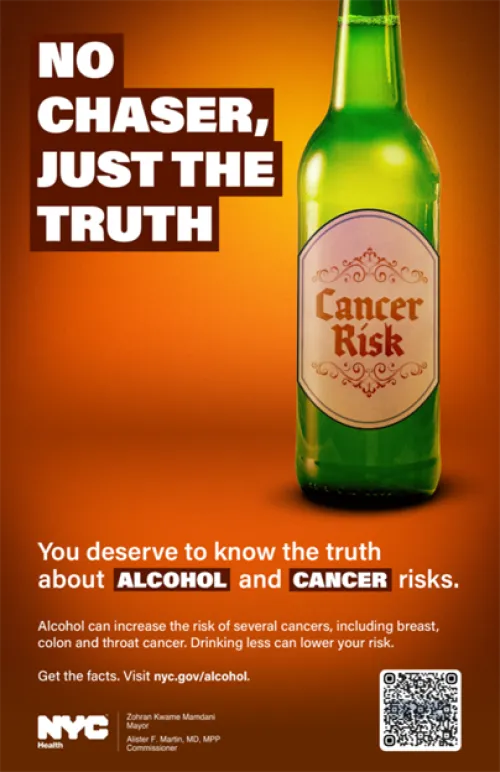
Last month, the New York City Health Department launched an exceptional advertising campaign dubbed “Buzzkill.” Its message: Alcohol causes cancer. Unlike most local government publicity campaigns, Buzzkill’s success will persuade consumers not to spend money in stores, restaurants, and bars across the city. Industry allies have characterized the ads as “scare tactics” and questioned whether they represent “a sign of similar policies to come.” Let’s hope so.
The Buzzkill campaign fits into a broader public health agenda, HealthyNYC, that sets measurable goals for increasing New Yorkers’ life expectancy. By 2030, the city aims to reduce fatal drug overdoses by 25%, homicides by 30%, suicides by 10%, COVID deaths by 60%, maternal mortality by 10%, heart and diabetes-related deaths by 5%, and “screenable cancer” deaths by 20%.
nyc.gov.
A lot of these “screenable cancer” deaths are attributable to alcohol. Yet many New Yorkers are not aware of the relationship between alcohol and cancer, and that, for example, even moderate drinking significantly increases the risk of breast cancer. The Buzzkill campaign seeks to change that.
This is important work. For decades, survey data has pointed to widespread confusion regarding alcohol’s contribution to cancer risk. One of the most rigorous examinations of public awareness is the National Cancer Institute’s Health Information National Trends Survey (HINTS). Researchers last year published an analysis of 5,937 HINTS respondents’ answers to the question “Have you ever heard or read that alcohol increases the risk of cancer?” in 2022: “40.6% of respondents were aware that alcohol increases cancer risk, 39.1% were not aware, and 20.4% were uncertain.”
Concerningly, 10% of respondents in a 2020 HINTS survey had indicated that “drinking wine” decreases cancer risk by “a little” or “a lot.” It does not. The variability in the HINTS survey complicates any assessment of how awareness of alcohol cancer risk is changing, however, more recent data offers a glimmer of hope.
The 2024 HINTS asked the related question “In your opinion, how does drinking alcohol affect the risk of getting cancer?” and just 9% of respondents said it “has no effect on the risk of cancer” with 36.1% saying it “increases the risk” and a whopping 52.4% reporting they “don’t know.”
Recent data from the American Institute for Cancer Research offers more compelling evidence that the health halo around alcohol is dimming. Between 2001 and 2019, AICR asked: “Which of the following do you believe has a significant effect on whether or not the average person develops cancer?” with respondents able to answer “yes,” “no,” or “don’t know” for risk factors including “tobacco,” “excessive exposure to sunlight,” and of course, “alcohol.” Awareness fluctuated during those years, but never exceeded half. In 2019, just 45% of respondents answered “yes.” In the most recent survey conducted in December 2024, however, that figure jumped to 58%.
These results are all the more remarkable considering that AICR conducted its survey a month before the US Surgeon General issued its Advisory on Alcohol and Cancer Risk. That Advisory should dispel any doubts about the scientific consensus on alcohol and cancer. “Alcohol consumption is the third leading preventable cause of cancer in the United States, after tobacco and obesity,” causing nearly 100,000 cases of mouth, throat, larynx, esophogeal, breast, liver and colon cancers in 2019, according to the Surgeon General. Women are particularly affected, with “an estimated 44,180 cases” or “16.4% of the approximately 270,000 total breast cancer cases for women” attributable to alcohol. The Advisory recommends an “update” to “the existing Surgeon General’s health warning label on alcohol-containing beverages to include a warning about the risk of cancer associated with alcohol consumption.”
Unfortunately, Congress must take action to update the warning label on alcohol, and it has shown little inclination to revisit the 1988 law requiring the current health warning statement. Meanwhile, the alcohol industry continues to spend more than $1.4 billion each year on advertising to shore up hard won associations between alcohol and glamour, romance, and success. Online marketing activities, ungoverned by the voluntary industry codes that apply to other media, raise particular concerns about youth exposure to alcohol-branded content. This exposure is associated with more binge drinking and other alcohol-related risks. Online advertising also incorporates ever more intrusive surveillance of data ranging from consumers’ location to social media activity to the movements of a computer mouse.
The scale and sophistication of advertising poses a grave challenge to publicly funded counter marketing campaigns like New York’s. The city spent roughly $1 million on the “Buzzkill” campaign, according to public health officials, which enabled it to run ads just for the month of May. This is not to say that the campaign did not break important ground, but combatting privately funded ads with publicly funded ads seems like a lopsided contest. Fortunately, policymakers have other tools at their disposal.
Six months after the Surgeon General’s Advisory, the American Medical Association adopted its own policy in support of cancer warnings on alcohol. But the AMA policy goes beyond alcoholic beverage labels to endorse requirements for “health education labels,” e.g. cancer warnings, on “all alcoholic beverage advertising.” Unlike the health warning statements on alcohol labels, which Congress has preempted state legislators from updating, cancer warning requirements on alcohol advertising are fair game. Such a policy would leverage the industry’s metaphorical megaphone to deliver objective, unbiased information about product harms, helping consumers make more informed purchases, or perhaps sign up for a cancer screening.
State and local policymakers can also protect consumers by providing a much needed check on surveillance advertising for all types of products, not just alcohol. CFA is currently working with the Electronic Privacy Information Center, with the help of a grant from the Center for Science in the Public Interest, to catalogue harmful, surveillance-driven food marketing practices that undermine equitable access to affordable, healthy food, and lift up policy solutions to counter the worst abuses. In some jurisdictions, simply enforcing existing privacy laws could lead to important progress, particularly for children. In others, new protections, such as bans on using consumers’ personal data for “surveillance pricing” are being legislated.
Despite enormous potential for improving public health, restrictions on advertising face an uphill battle. This is precisely because ads are so valuable to profit-seeking enterprises like the alcohol industry. But programs like New York City’s serve as a reminder that government exists to serve the people, not boost corporate profits. Promoting economic growth is important, but it cannot come at the expense of public health; an economy built on products and services that compromise health will eventually falter. CFA will continue to work with advocacy partners and policymakers to protect consumers and hold up policy innovations that build widespread prosperity.
By working with state and local policymakers to protect consumers, CFA and our advocacy partners are setting the foundation
Thomas Gremillion is the Director of Food Policy at the Consumer Federation of America. He advocates for improving food safety protections for consumers, including through his work with the Safe Food Coalition, a group of consumer, trade union, and foodborne illness victim organizations dedicated to reducing foodborne illness by reforming government food inspection programs. A graduate of Harvard Law School, La Universidad Andina Simón Bolívar, and the University of South Carolina, Gremillion is passionate about identifying and implementing public policies to give more consumers access to affordable, safe, and nutritious food.
Director of Food Policy, Consumer Federation of America
Donate to CSPI today
CSPI heavily relies on our grassroots donors to fuel our mission. Every donation—no matter how small—helps CSPI continue improving food access, removing harmful additives, strengthening food safety, conducting and reviewing research, and reforming food labeling. We don't take donations from corporations, and our flagship publication, Nutrition Action, doesn't run any ads. That means that everything we do is fiercely independent and unbiased from any bad actors, no matter how powerful. To help keep this online content 100% free, consider donating today to support CSPI.