Tired of expensive skincare products that don’t work? To get the most for your money, pare down your routine to the fundamentals that prevent and treat skin aging. Here are the anti-aging ingredients dermatologists recommend (and one they don’t) to improve skin health, minimize wrinkles, and spare your wallet.
Retinoids are the gold standard for wrinkles
“Retinoids are compounds derived from vitamin A,” explains Michelle Wong, a chemist and author of “The Science of Beauty.” “They’re gold-standard skincare ingredients because there’s abundant evidence that they work for common skin-aging concerns like wrinkles and dark spots.”
How do retinoids work?
“They stimulate collagen production and increase cell turnover,” says Debra Jaliman, an assistant clinical professor of dermatology at the Icahn School of Medicine at Mount Sinai. “That improves skin texture, softens lines, and fades discoloration.”
Skin aging isn’t a disease that needs to be treated, and forgoing the pursuit of youth has its own perks. But if you want to try a retinoid, you have a dizzying number at your disposal. They fall into two main camps—prescription or cosmetic:
Prescription retinoids
“They are more regulated and reliable than cosmetic retinoids,” says Wong. That’s because randomized trials have to show that they actually work.
Tretinoin (Retin-A) and tazarotene are both FDA-approved prescription drugs for wrinkles. In contrast, trifarotene (Aklief) and adapalene aren’t as well studied for anti-aging. (Both are primarily used to treat acne.) While you can get a weaker formulation of adapalene as an over-the-counter drug, it’s no sure bet for skin aging.
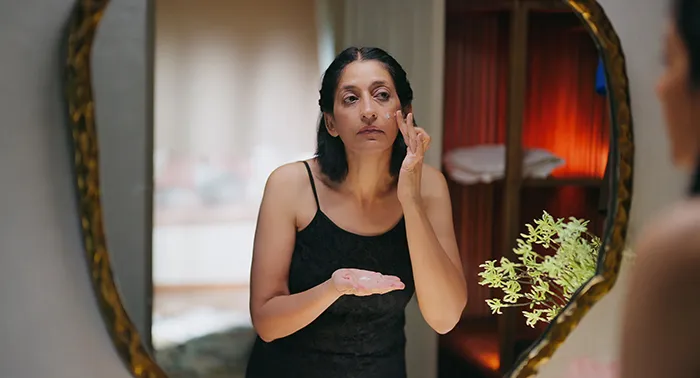
Retinoids, the “gold standard” among topical anti-aging ingredients, should be applied at nighttime because most aren’t stable in sunlight.
Raushan_films - stock.adobe.com.
“Tretinoin is the most studied and generally the most potent retinoid because it’s already in an active form,” says Jaliman. (Unlike other retinoids, your skin cells can use tretinoin without first converting it to active vitamin A.) “If you have significant sun damage or deeper wrinkles, prescription retinoids like tretinoin often provide more dramatic results.”
That said, “more dramatic” doesn’t mean miraculous. While tretinoin is the best anti-aging topical on the market, it’s no fountain of youth. (A “topical” cream, lotion, or serum is one that you rub on your skin.)
For example, an analysis of eight randomized trials in 1,361 adults found that those using tretinoin for up to two years had only modest reductions in fine and coarse wrinkles compared to those using a placebo. (The trials were largely funded by pharmaceutical companies.)
What’s the downside of retinoids? They’re notoriously irritating, though that lessens with time. To minimize irritation, “start by applying a retinoid just two to three nights per week, then increase the frequency as tolerated,” says Jaliman. Going overboard risks peeling, redness, burning, itchiness, or dryness.
“If you have severe eczema, rosacea, or otherwise-sensitive skin, you may not be a good candidate for prescription retinoids,” Jaliman adds.
Cosmetic skincare retinoids
If your skin is sensitive, consider gentler retinoid products, says Wong. Their active ingredients—like retinol, retinaldehyde (aka retinal), and retinyl esters—are regulated as cosmetics (not drugs), so you can find them in off-the-shelf lotions, creams, and serums.
“Retinal and retinol are potentially the most effective, though they tend to be less stable and are the most irritating of the cosmetic bunch,” says Wong. But they’re still gentler than tretinoin, Jaliman notes.
If your skin is especially sensitive, or if you’re already using other irritating skin ingredients (like alpha-hydroxy acids or vitamin C) and don’t want to pile on, consider an ester: Look for retinyl retinoate, retinyl palmitate, or retinyl acetate among the ingredients. “There’s a lot less evidence for them,” says Wong, “but they seem to be a lot gentler.”
One challenge when shopping for cosmetic retinoids: finding one that’s stable and potent. “Some products are carefully tested,” while others are not, Wong notes. “Go for a brand that invests a lot in research and development.” Neutrogena, RoC, L’Oréal, Olay, and other multinational brands are typically a safe bet, she says.
A few words of caution for topical retinoids:
Apply them at night. (Most retinoids can break down in the sun.)
Wear sunscreen during the day. (Retinoids can make your skin burn more easily.)
As we age, our skin turns over at a slower pace. (That’s just another way of saying that the cells in our skin are replenished less often.) Enter chemical exfoliants like alpha-hydroxy acids.
“They help remove dead skin cells, which increases turnover,” says Jaliman. “That can brighten dull skin, even out dark spots, smooth out roughness, and stimulate some collagen production.” And that means more uniform skin tone and texture.
So if your skin could use a pick-me-up, consider an alpha-hydroxy acid. Look for ingredients like glycolic acid, lactic acid, or mandelic acid in your serum, cleanser, lotion, or at-home peel.
“Glycolic acid penetrates best because it has the smallest molecular size,” says Jaliman. That can make it a bit too irritating for some. “Lactic acid is often gentler and also hydrates skin,” she adds. Both seem to work equally well.
For example, in one trial (funded by a skincare company), researchers randomly assigned 67 middle-aged and older women to apply an 8% glycolic acid cream, an 8% lactic acid cream, or a cream without either acid twice a day to their faces and outer forearms. After 22 weeks, more than 70% of those using either acid-containing cream showed modest improvements (determined by the researchers) in signs of visible aging like skin yellowing and roughness, while just 41% of those using the placebo cream showed improvement.
Still, alpha-hydroxy acids can be a double-edged sword.
With overuse, “these chemical exfoliants can cause irritation, redness, dryness, and increased sensitivity to sunlight,” Jaliman cautions. That can be a particular problem for people with darker skin tones. “Too much irritation can trigger post-inflammatory hyperpigmentation—discoloration that’s more visible in deeper shades of skin and that can take months to years to fade.”
Most people can tolerate using a leave-on chemical exfoliant every day (as opposed to a more potent at-home peel that you wash off) if the concentration is 20% or lower. Just make sure to wear sunscreen outdoors, since sunlight can worsen irritation and hyperpigmentation. If you have rosacea or sensitive skin, Jaliman suggests picking a chemical exfoliant with an even lower concentration or skipping one altogether.
Topical vitamin C protects skin against environmental assaults
“Vitamin C is an antioxidant, so it can soak up free radicals that damage skin,” says Wong.
Free radicals? They’re compounds that, in high amounts, can drive harmful inflammation and speed up aging. Our bodies produce them every day, but production can kick into overdrive in response to ultraviolet light from the sun. Other common sources of free radicals include air pollution and cigarette smoke.
Serums are popular formulations for alphahydroxy acids and topical vitamin C.
kegfire - stock.adobe.com.
“In the short term, a vitamin C product can reduce skin redness and burns caused by sunlight,” says Wong. Long term, “it may lessen the damage that leads to signs of aging, like dark spots, fine lines, and wrinkles.” It’s also essential for building collagen and it helps even out skin tone, Jaliman adds.
Vitamin C comes in many forms. L-ascorbic acid is the most studied and may be the most potent, says Wong. (We’d need more research on the other forms to know for sure.)
In one small study, 19 middle-aged women applied a 5% L-ascorbic acid cream to one side of their upper chest and a placebo cream to the other side every day. After six months, skin treated with L-ascorbic acid improved in wrinkling and hydration compared to skin treated with the placebo. (Note: One of the study’s coauthors was employed by La Roche Posay, the maker of the L-ascorbic acid product used in the study.)
One drawback: L-ascorbic acid degrades easily. So look for products that contain stabilizers like vitamin E and ferulic acid, says Wong.
Those formulations can be more irritating, though. If that’s a dealbreaker, opt for a gentler, more stable form of vitamin C like tetrahexyldecyl ascorbate, ascorbyl glucoside, or magnesium ascorbyl phosphate, Jaliman says. Just know that they haven’t been as well studied.
Concentrations between 10% and 20% are optimal, says Jaliman. But whatever formulation you choose, “look for opaque, airtight packaging, because vitamin C degrades with exposure to light and air.” Containers with pumps are more airtight than those with lids or droppers.
If your product has turned orange or brown, says Jaliman, “it’s likely oxidized and may no longer be effective.”
Is topical estrogen an anti-aging gamechanger?
“Estrogen is thought to play a role in maintaining skin’s collagen, thickness, hydration, and elasticity,” says Shoshana Marmon, an assistant professor of dermatology at New York Medical College. That’s why the sharp decline in estrogen during menopause can help drive facial aging.
Prescription estrogen gels are FDA approved for hot flashes, and estrogen creams are approved for vaginal symptoms like dryness. Though not approved for skin aging, both are sometimes prescribed “off label” to women for that purpose.
Can topical estrogen turn back the clock on our skin’s appearance? It’s complicated.
“Some studies suggest that topical estrogens—namely estriol and estradiol—may boost skin thickness and improve hydration, elasticity, and fine wrinkling” in older women, says Jaliman.
Estriol is a weaker form of estrogen, while estradiol is the most potent form that our bodies make. Both worked equally well for skin aging when they were compared head-to-head, says Marmon.
In the one randomized trial that tested both, 58 middle-aged and older women applied either a 0.01% estradiol cream or a 0.3% estriol cream to their faces every day. After six months, those in both groups showed marked improvements in skin wrinkling, hydration, firmness, and collagen density. But the estrogens weren’t tested against a placebo.
While estriol and estradiol haven’t been tested against the gold standard (retinoids), one trial pitting a 0.01% estradiol cream against an alpha-hydroxy acid (15% glycolic acid) cream in 30 postmenopausal women found similar anti-aging benefits after six months. Evidence for anti-aging effects of other estrogens—like estrone and the conjugated equine estrogen Premarin—is scarce.
If your primary skin concern is dark marks, though, topical estrogens may not help. Loss of estrogen is mainly linked with skin dryness and thinness, says Marmon. “That’s distinct from aging caused by ultraviolet light from the sun,” which can cause discoloration, wrinkles, and skin cancer. “In fact, discoloration has been reported as an adverse effect in some topical estrogen studies.”
And be wary of estrogen creams that you can get without a prescription. They often have even less data behind them, Marmon cautions. “Overall, the marketing around topical estrogens has outpaced the evidence” for their use in skin aging.
Are topical estrogens safe?
Taking estrogen systemically from, say, pills or gels for symptoms of menopause appears to be more beneficial than harmful for women under 60 or those who’ve been in menopause for less than 10 years. That said, too much estrogen can increase the risk of breast cancer, uterine cancer, and blood clots. (Age, years of use, health history, and other factors matter to your risk level.)
Likewise, topical estrogen creams applied vaginally appear to be safe because systemic absorption is minimal. Does that mean topical estrogens are also safe for skin aging?
“The studies we have are small and not designed to assess long-term safety,” Marmon cautions. Safety likely boils down to the product, dose, size of the area you’re treating, and how long you use it for, she adds.
Though most studies haven’t shown concerning changes in hormone levels in the blood, at least one study flagged an increase in estrogen levels in those using 0.2% topical estrogen for skin aging. And some participants in other studies have reported breast tenderness, a possible sign of too much estrogen exposure, Jaliman adds.
Her take: If you have a history of estrogen-sensitive cancers like breast cancer or blood clotting disorders, topical estrogen probably isn’t worth the risk.
The bottom line: Topical estrogens come with safety concerns and may not be more effective than anti-aging mainstays like retinoids, vitamin C, and alpha-hydroxy acids.
CSPI heavily relies on our grassroots donors to fuel our mission. Every donation—no matter how small—helps CSPI continue improving food access, removing harmful additives, strengthening food safety, conducting and reviewing research, and reforming food labeling. We don't take donations from corporations, and our flagship publication, Nutrition Action, doesn't run any ads. That means that everything we do is fiercely independent and unbiased from any bad actors, no matter how powerful. To help keep this online content 100% free, consider donating today to support CSPI.