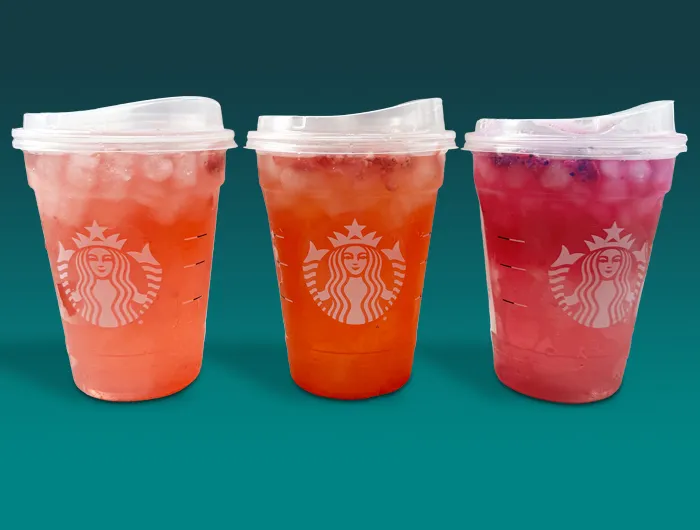
Why does Starbucks now offer some 20 different Refreshers? Simple: To get you—and your wallet—in the door after the morning coffee rush.

“Midday and afternoon dayparts generate $11 billion in sales after 11:00 a.m., and we believe there is room to create a true second peak,” wrote a Starbucks marketing exec a day before the launch of the chain’s new “Energy Refreshers” lineup. “Winning the afternoon means meeting customers where they are later in the day.”

To Starbucks, that means marketing caffeine in dressed-up sugary drinks. 


This article comes from Nutrition Action. We don’t accept any paid advertising or corporate or government donations. Any products we recommend have been vetted by our staff and are not advertisements by the manufacturers. They’re just healthier alternatives we think you’d like to know about! 


What’s a Starbucks Energy Refresher?

“New Energy Refreshers just dropped,” says Starbucks’s website. “Now you can enjoy the Refreshers you love with extra caffeine from nature and a B-vitamin boost.”

“Caffeine from nature”? Refreshers get their jolt from a “green coffee extract blend.” Translation: the caffeine comes from unroasted coffee beans instead of brewed coffee.

As for the “B-vitamin boost,” that means added vitamins B-3, B-5, B-6, and B-12. While getting enough B vitamins helps you convert food into energy, most of us already consume plenty. So don’t assume that getting extra will make you feel more energetic. (Caffeine, on the other hand, will.)

And even if you could use more B vitamins—some older adults, for example, need supplemental B-12—you shouldn’t rely on the occasional Refresher. (Starbucks doesn’t disclose how much the drinks contain in the nutrition information posted on their website and app.)

How much caffeine is in Starbucks Refreshers?

If you’re wondering how much caffeine is in an original Starbucks Refresher, a new Energy Refresher, a Lemonade Refresher, or any other drink on the growing “Refreshers” menu, so were we. That’s why we created the chart below.

Take a (16 oz.) grande. An original Refresher has 50 milligrams of caffeine, while an Energy Refresher delivers more than twice that much (125 mg).

Both have less caffeine than a grande iced coffee (185 mg), though a coffee in the morning plus a Refresher in the afternoon can add up. Caution: A midday Refresher could disturb your sleep at night, depending on how much caffeine it has, how late in the day you drink it, and how sensitive you are to caffeine. (Note: You can now order any original Refresher caffeine-free.)

Here’s how much caffeine you’ll get in a tall (12 oz.), grande (16 oz.), venti (24 oz.), or trenta (30 oz.) original Refresher or Energy Refresher compared to a regular Starbucks iced coffee. 

How much caffeine is too much?

For most healthy adults who aren’t pregnant, consuming up to 400 milligrams of caffeine a day is “not generally associated with negative effects,” says the Food and Drug Administration. But that daily dose may—or may not—be too much for you. People vary in how quickly their bodies break down caffeine and how sensitive they are to its effects. (Another thing to keep in mind: certain medications can interact with caffeine.)

None of the Refreshers come close to 400 mg of caffeine. The largest (trenta) Energy Refresher, for example, clocks in at 175 mg. But if you have, say, a venti iced coffee in the morning and a venti Energy Refresher in the afternoon, you’ll hit 415 mg for the day.

For children and teens, the American Academy of Pediatrics and other health authorities recommend avoiding caffeine altogether, especially energy drinks.

Learn more: How much caffeine is in coffee, tea, soda, and other foods? 


How much sugar and how many calories are in Starbucks Refreshers?

Starbucks Refreshers range from 16 grams of total sugars and 70 calories (a tall Strawberry Açaí) to a whopping 79 grams of total sugars and 360 calories (a trenta Mango Strawberry Lemonade). For a full list of sizes and flavors, check our chart below.

A venti (24 oz.) size of any original or Energy Refresher has about as many calories as a 12 oz. can of Coke. The same goes for a grande (16 oz.) size of any Lemonade Refresher.

And if you’re looking to get some fruit from your Refresher, keep in mind that while they may have Mango, Strawberry, Dragonfruit, or Açai in their names, their “base” is mostly water, added sugar, and white grape juice concentrate plus “fruit and vegetable juice concentrate for color.”

In fact, the Mango Dragonfruit has no actual mango—only natural flavor—and its only dragonfruit is a scoop of freeze-dried pieces. Likewise, the Strawberry Açaí has no açai, the Mango Strawberry has no mango, and the strawberries in both are freeze-dried. Hmm…we’re sensing a theme. 


What’s a lower-sugar caffeinated drink?

Most “Refresher” drinks at competing chains like Dunkin’ and Panera are at least as sugary as Starbucks’s versions. So where can you find a caffeine boost without a sugar boost?

For adults who can tolerate an afternoon dose of caffeine, look for a drink that’s sweetened with (safe) stevia extract, like a just-add-water packet of True Lemon Energy Drink Mix or a can of Zevia Zero Sugar Energy Drink. Each has 120 milligrams of caffeine per serving and no more than a gram of added sugars.

Dunkin’s new Zero Sugar Energy drinks have 145 mg of caffeine in a medium. They’re sweetened with stevia extract plus allulose, which is a naturally occurring sugar that our bodies don’t completely digest and absorb, so it may cause GI troubles in sensitive people who consume too much at one time. That’s why we rate allulose as “cut back.”

To go lighter on caffeine, try a caffeinated lower-sugar, stevia-sweetened soda like some Poppi varieties: A 12 oz. can of Poppi Alpine Blast, for example, has 55 mg of caffeine, while a Cherry Cola, Classic Cola, or Doc Pop has 40 mg. (Poppi also sells caffeine-free flavors.) 

How much caffeine and sugar and how many calories are in Starbucks Refreshers?

Within each section, our chart is ranked from least to most caffeine, calories, and total sugars. At Starbucks, an iced tall drink is 12 oz., a grande is 16 oz., a venti is 24 oz., and a trenta is 30 oz. 

Donate to CSPI today

CSPI heavily relies on our grassroots donors to fuel our mission. Every donation—no matter how small—helps CSPI continue improving food access, removing harmful additives, strengthening food safety, conducting and reviewing research, and reforming food labeling. We don't take donations from corporations, and our flagship publication, Nutrition Action, doesn't run any ads. That means that everything we do is fiercely independent and unbiased from any bad actors, no matter how powerful. To help keep this online content 100% free, consider donating today to support CSPI.

A monthly gift helps more
Be part of our next win.