

How SNAP and Medicaid Cuts Threaten Children’s Access to Federal Nutrition Programs
CSPI.
H.R. 1 sharply reduced access to SNAP and Medicaid, two major programs that provide for the health and well-being of people with low incomes. While H.R. 1 did not directly limit access to nutrition programs for children, cuts to SNAP and Medicaid disrupt the eligibility and certification pathways that connect children to the programs meant to keep them from going hungry.
Much of that disruption has not yet surfaced. Because area eligibility determinations hold for five years and school reimbursement rates hold for up to four, many schools and meal sites are still operating on certification data collected before H.R. 1 went into effect in July 2025. The losses will be felt over time, school by school, as those determinations come up for renewal.
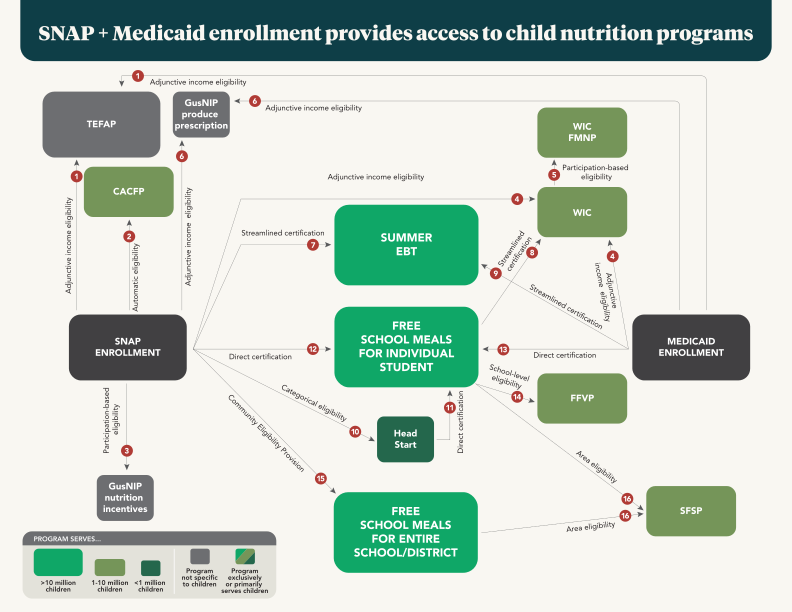
The following diagram shows how enrollment in SNAP and Medicaid confer access to federal programs that feed children.
- Enrollment in SNAP or Medicaid may confer adjunctive income eligibility for USDA foods at distribution sites through The Emergency Food Assistance Program (TEFAP). Adjunctive income eligibility means that the household’s income requirement is automatically satisfied based on participation in another program, with no separate income determination needed. Depending on state policy, when a person wants to access TEFAP, such as through a food pantry, they can claim income eligibility by sharing that they participate in SNAP or Medicaid.
- For children attending a facility that participates in the Child and Adult Care Food Program (CACFP), such as a daycare, the household’s participation in SNAP qualifies the child for free meals.
- When a SNAP participant has access to a nutrition incentive program funded by a Gus Schumacher Nutrition Incentive Program (GusNIP) grant, they have extra purchasing power for fruits and vegetables at participating food retail locations.
- Enrollment in SNAP or Medicaid confers adjunctive income eligibility for the Special Supplemental Nutrition Program for Women, Infants, and Children (WIC), which provides benefits for purchasing nutritious foods to mothers and families with young kids. In addition to income eligibility, WIC participation requires a nutritional risk determination from a health professional.
- When a WIC participant lives in a state operating a WIC Farmers Market Nutrition Program (FMNP), they have additional purchasing power for fresh produce at participating locations.
- When a patient enrolled in Medicaid or eligible for SNAP is seen at a clinic partnered with a GusNIP produce prescription grantee and is managing or at risk of a diet-related health condition, their provider prescribes fresh fruits and vegetables, which they may redeem for free or at a reduced cost at participating locations.
- In states that operate Summer Electronic Benefit Transfer (Summer EBT) program, school-aged children in SNAP households are automatically enrolled in Summer EBT and receive grocery benefits for use at SNAP-authorized retailers over the summer when school is not in session.
- In states that operate Summer EBT, children who are certified for free or reduced-price (FRP) meals are automatically enrolled in Summer EBT.
- In states that both use Medicaid data for direct certification and operate Summer EBTi, income-eligible children enrolled in Medicaid are automatically enrolled in Summer EBT.
- Children from SNAP households are categorically eligible for Head Start, which provides preschool education, health screenings, and meals reimbursed through CACFP.
- Children enrolled in Head Start are directly certified for free school meals.
- Children from SNAP households are directly certified for free school meals without an application.
- In states that use Medicaid data for direct certification, income-eligible children enrolled in Medicaid are certified for free school meals, or in some states for FRP meals, without an application.
- Elementary schools with the highest percentage of children certified for FRP meals may apply for the Fresh Fruit and Vegetable Program (FFVP), which provides fresh fruits and vegetables to students during the school day.
- Students directly certified through SNAP count towards a school’s identified student percentage (ISP), the share of students certified for free meals without an application. A school, group of schools, or entire district with an ISP of at least 25 percent can adopt the Community Eligibility Provision (CEP) and serve free meals to all students without collecting applications. ISP also determines how much of that food is paid with federal funds. The ISP is multiplied by 1.6 to set the percentage of meals reimbursed at the federal free rate, with the rest reimbursed at a lower rate. Reimbursement rates hold for up to four years, and schools may recalculate annually to capture a higher ISP.
Non-school meal service locations (e.g., home-based daycares) that are located in the attendance area of a non-CEP school qualify for area eligibility when at least 50 percent of children at the school are certified for FRP. For a CEP school or district, area eligibility is conferred when its ISP is at least 31.25 percent. Area-eligible sites can serve meals to all children in the neighborhood through the Summer Food Service Program and at afterschool and enrichment programs, and home-based daycares participating in CACFP receive the highest tier reimbursement rate for food. Area eligibility determinations hold for five years.
i Streamlined certification for Summer EBT can be done through means-tested programs, and some states designate Medicaid as one such program.